Key Takeaways
- I cannot tell you whether your policy will pay. Nobody writing a travel blog can. What I can do is show you the four clauses that decide it.
- The most common exclusion is the licence one. Many policies only cover you if you were legally entitled to ride that machine, in that country.
- Engine size is the second clause, and it catches people out because the popular Loop bikes sit above the common cut-off.
- There are three separate things called insurance here, and only one of them is about your hospital bill.
- Read the policy wording before you ride, not after. Fifteen minutes now, and you will know where you stand.
Disclosure, before anything else
This site sells you nothing. No policies, no comparison links, no affiliate commission. I am not naming an insurer anywhere on this page, and that is deliberate: insurance content online is almost entirely commission-driven, and I would rather be useless to you commercially than useful to somebody’s affiliate account. I do still own a share of a Ha Giang tour company I no longer run, which is disclosed on every page here.
I want to be honest about the limits of this page before you read it.
I cannot tell you whether your insurance will pay out. That depends on your policy, your insurer, your licence, and the circumstances of the incident. Anybody who tells you otherwise on a travel blog is guessing, and if they have an affiliate link next to the claim, they are guessing in a particular direction.
What I can do is tell you which clauses decide it, and how to find them in the document you already have.
Which insurance are we even talking about?
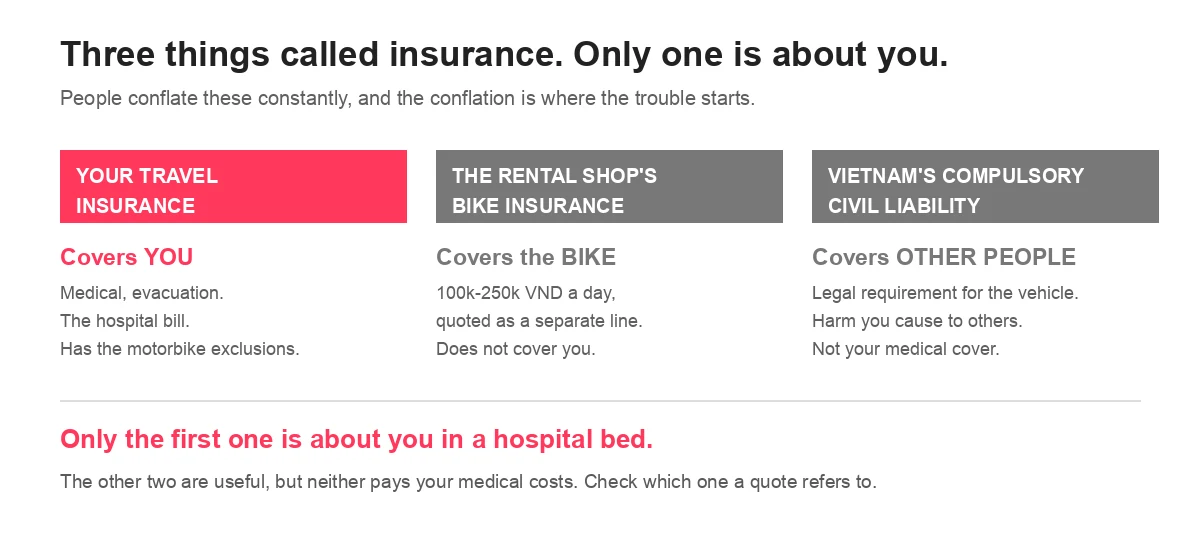
People conflate these constantly, and the conflation is where the trouble starts.
Your travel insurance. Bought at home, covers medical treatment, evacuation, and sometimes cancellation. This is the one that matters for a hospital bill. It is also the one with the motorbike exclusions.
The rental shop’s bike insurance. The separate line on the rental price list, typically 100,000 to 250,000 VND a day. It covers damage to the machine. It does not cover you. See the rental price breakdown for how that line is quoted.
Vietnam’s compulsory civil liability certificate. A legal requirement for the vehicle, covering harm you cause to other people. Not your medical cover. Riding without it carries its own penalty under Nghị định 168/2024/NĐ-CP, Điều 18 khoản 2(b).
Three different products, three different purposes. Only the first one is about you in a hospital bed.
The four clauses that decide whether you are covered
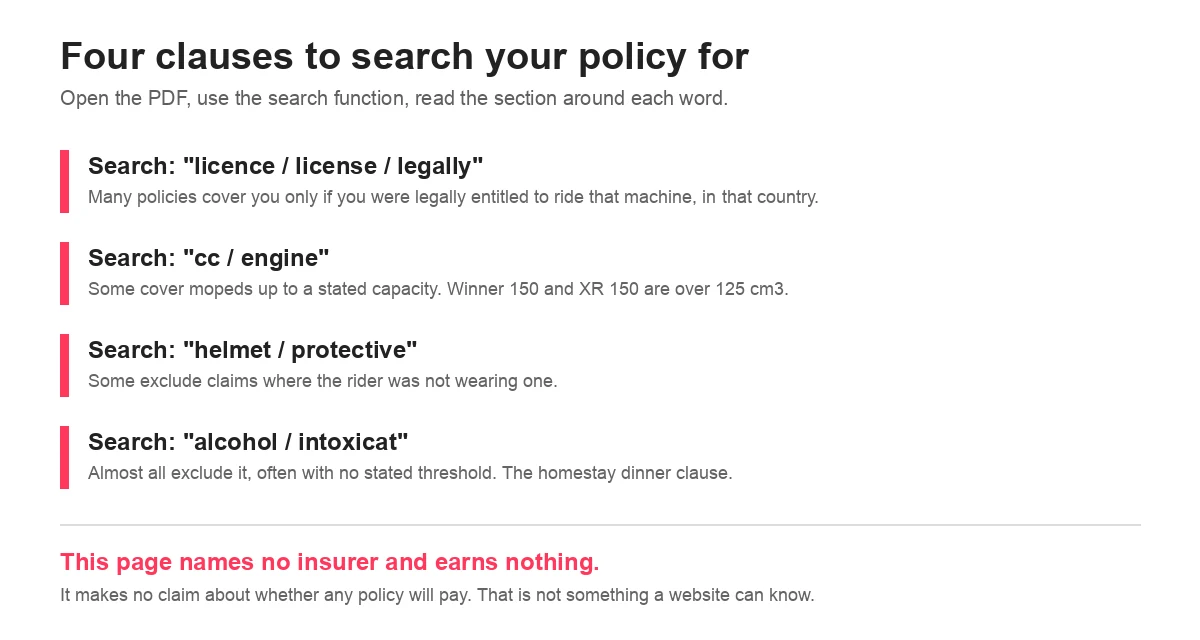
Open your policy document and search it for these. Every policy is different, so I am telling you what to look for rather than what yours says.
1. The licence clause. Search for “licence”, “license” and “legally”. Many policies cover motorcycling only if you were legally permitted to ride that vehicle in the country you were in. Vietnam changed its classes on 1 January 2025: class A1 covers up to 125 cm³ and class A covers above it, under Luật số 36/2024/QH15, Điều 57, retrieved 2026-08-02.
2. The engine size clause. Search for “cc” and “engine”. Some policies cover mopeds up to a stated capacity and exclude anything larger. This matters here because the bikes most often rented for the Loop, the Winner 150 and the XR 150, are over 125 cm³.
3. The helmet clause. Search for “helmet” and “protective”. Some policies exclude claims where the rider was not wearing one. Wear it regardless, but know whether your policy makes it a condition.
4. The alcohol clause. Search for “alcohol” and “intoxicat”. Almost every policy excludes incidents where the rider had been drinking, often with no stated threshold at all. This is the clause that quietly removes cover after a homestay dinner.
Two of those four clauses point at the same document, which is why the licence question keeps coming back on this site. Vietnam’s classes are set by engine size under Luật số 36/2024/QH15, Điều 57, in force since 1 January 2025 and retrieved 2026-08-02. So the engine size of the bike you rent decides which licence class you need, and your licence class is what the insurance clause is testing. One rental decision moves both.
That is also why I would read the policy before choosing the bike rather than after. It is the only order in which the information is any use to you.
Do this now rather than at the airport. Open the PDF, use the search function, and read the four sections around those words. Fifteen minutes, and you stop guessing about the most expensive uncertainty of the trip.
Why does the licence clause matter most here?
Because it is the one people assume they have satisfied and often have not.
The UK Foreign Office states plainly that British riders need both a 1968-convention International Driving Permit and their home licence to ride legally in Vietnam, and that driving without third-party insurance is illegal. You can read that on the UK government’s Vietnam travel advice, retrieved 2026-08-02. Most other foreign ministries publish an equivalent page.
Now hold that next to a policy clause that only covers you when you were legally entitled to ride. If those two documents disagree with what is actually in your wallet, the gap is not academic. It is the difference between a bill somebody else pays and a bill you pay.
I am not going to tell you that any policy will or will not pay in your situation, because I do not know and neither does any other website. What I will say is this: the licence question is settled before you ride, not after. Sort it while you can still change the answer. The full version is in whether you need a licence here.
What about the fine, separately?
Worth separating from the insurance question, because they are two different consequences of the same gap.
Riding without a licence Vietnam accepts carries penalties in its own right. Under Nghị định 168/2024/NĐ-CP, Điều 18, retrieved 2026-08-02, there are two brackets by engine size, and the larger one applies to most of the bikes rented for this route.
So there are two costs, not one. The fine is the visible one. The insurance consequence is the expensive one, and it only shows up on the worst day of the trip.
If something does happen

Practical, in order.
- Get medical help first. Call 115 for an ambulance. Argue about paperwork later; nobody’s insurance improves because they delayed treatment.
- Tell your insurer as soon as you reasonably can. Many policies require prompt notification, and some require pre-authorisation before non-emergency treatment.
- Keep everything. Receipts, discharge notes, the police report if there is one, photographs. Claims are decided on documents.
- Do not sign anything you cannot read. Ask for a translation, or ask somebody who speaks both languages to read it with you.
The wider emergency sequence, including which towns have medical facilities, is in the safety guide.
Should you ride if you are not sure you are covered?
That is your call, and I am not going to make it for you or pretend it is simple.
What I will say is that “I think I am probably covered” is a sentence people say before a trip and never after. If reading the four clauses leaves you genuinely unsure, the two clean answers are to sort the licence, or to ride pillion with somebody who has one. The second option is discussed properly in riding with no experience.
A note on method: this page names no insurer, links to no comparison site, and earns nothing. It makes no claim about whether any policy will pay, because that is not something a website can know about your circumstances. The legal points cite Vietnamese law and a foreign government rather than any operator or insurer, including the tour company I hold a share in.
Common questions
Does travel insurance cover motorbiking in Vietnam?
It depends entirely on your policy wording, and no website can answer it for your situation. Check four clauses: licence, engine size, helmet and alcohol. Many policies cover motorcycling only when the rider was legally entitled to ride that machine in that country.
What is the most common reason a motorbike claim is refused?
The licence clause. Riders assume a home car licence, or an International Driving Permit alone, is enough. Whether it is depends on both Vietnamese law and your policy wording, and those are two separate tests you need to pass.
Does the rental shop’s insurance cover me?
No. The insurance line on a rental price list, typically 100,000 to 250,000 VND a day, covers damage to the bike. It is not medical cover and it is not your travel insurance. They are separate products with separate purposes.
Does engine size affect my cover?
Often yes. Some policies cover machines only up to a stated capacity. This matters on the Ha Giang Loop because the commonly rented Winner 150 and XR 150 are over 125 cm³, which is also the boundary between Vietnam’s A1 and A licence classes.
What should I do immediately after an accident?
Get medical help first and call 115 if it is serious. Then notify your insurer as soon as you reasonably can, because many policies require prompt notification. Keep every receipt, discharge note and photograph, since claims are decided on documents.
Which insurer should I use for Vietnam?
I am not going to name one. Insurance content online is overwhelmingly commission-driven, and I have no way to know which policy fits your nationality, age, activities and existing cover. Read the four clauses in whatever you are considering, and choose on the wording rather than on a recommendation.
Fifteen minutes with the policy PDF before you ride is worth more than any article about insurance, including this one.
Written by Jasmine (Thuy Bui), born and raised in Ha Giang. This site sells nothing and carries no affiliate links. I co-founded Jasmine Ha Giang, a licensed local tour operator, and I still hold a share in it; the team there operates it without me. My work now is free advice for travellers and social projects in the province.
Leave a Reply