Key Takeaways
- Accidents here are real, and most of them are preventable. Four causes come up again and again: riding a manual bike you have not learned yet, weather that turns in minutes, overconfidence, and drinking or riding after dark.
- Nobody can tell you the accident rate on this road, including me. There is no reliable public count. Anyone quoting one is guessing, or is quoting a national figure that has nothing to do with this province.
- Your licence is a safety decision, not paperwork. Most travel insurance stops covering you the moment you ride without one that Vietnam accepts.
- A guided tour removes some decisions. It does not make the road safe. You are on the same bike, on the same pass, in the same fog.
- Save 115 and your driver’s number before you start the engine. The riders who know the emergency steps in advance are the calm ones when something happens.
Disclosure, before anything else
Two things before you read a word about safety. This site sells you nothing. No tours, no bookings, no affiliate links, no sponsorship. And I still own a share of Jasmine Tours, a licensed operator that runs this exact route. I co-founded it, I stepped back from running it, and the team there takes people round the Loop without me. But I benefit if you book with them.
I am telling you the second part precisely because of the first. A page with nothing to sell reads as neutral, and that is exactly when a stake you cannot see does the most damage. Everything below is written so you can check it: the legal points cite Vietnamese law, the road advice names real places, and where a number cannot be verified I say so instead of filling the gap.
You probably typed “Ha Giang Loop accidents” into a search box late at night, somewhere between booking the flight and telling your mother about the trip. That is a good instinct. In my experience the travellers who go looking for what can go wrong are the ones who come home fine.
So let me answer the question directly, then show my work.
Is the Ha Giang Loop dangerous? An honest local answer
Yes, it carries real risk. And no, it is nothing like the road a late-night search spiral makes it feel like.
The route runs from Ha Giang city up through Quan Ba (Quản Bạ), Yen Minh (Yên Minh), Dong Van (Đồng Văn) and Meo Vac (Mèo Vạc), mostly along QL4C, the road Ho Chi Minh named Đường Hạnh Phúc, the Happiness Road. It crosses the Dong Van karst plateau, which UNESCO designated in 2010 as Vietnam’s first Global Geopark. The road is paved for almost all of it. Local traffic moves slowly. These are working mountain roads that farmers and truck drivers use every day, not cliff-edge dirt tracks.
One small thing worth correcting, because it affects how you plan your days. You will see “350 km” quoted everywhere as though it were a fixed fact. There is no single distance, because there is no single loop. The classic three-day circuit runs somewhere around 330 to 350 km. Add the Du Gia (Du Già) leg that most four-day routes take and you are closer to 380 to 430 km. That is a difference of up to a full riding day, and it is the reason two people can both say they “did the loop” and mean quite different trips. Ask which version your route is before you judge whether three days is enough.
I am not going to quote you an accident statistic, and you should be suspicious of any page that does. There is no reliable public count of what happens to foreign riders on this road. The numbers you will find are either invented, or they are national road-safety statistics for the whole of Vietnam, which are dominated by city traffic and say nothing useful about a mountain pass in Ha Giang.
Here is what I can tell you instead, and I think it is more useful. The causes repeat. I have spent years watching travellers arrive in this province, get it right and get it wrong, and the same four mistakes come up over and over. Each one is a decision, not a stretch of tarmac. The mountain does not choose who gets hurt.
Here is the pattern I notice most. Everyone who books alone sends me the same three messages, and almost nobody asks the price first. The first question is always some version of this one: is the road dangerous? I have stopped being surprised by it. If you are reading this at midnight with a flight already booked, you are asking in the same order everyone else does.
What actually causes accidents on the Ha Giang Loop?
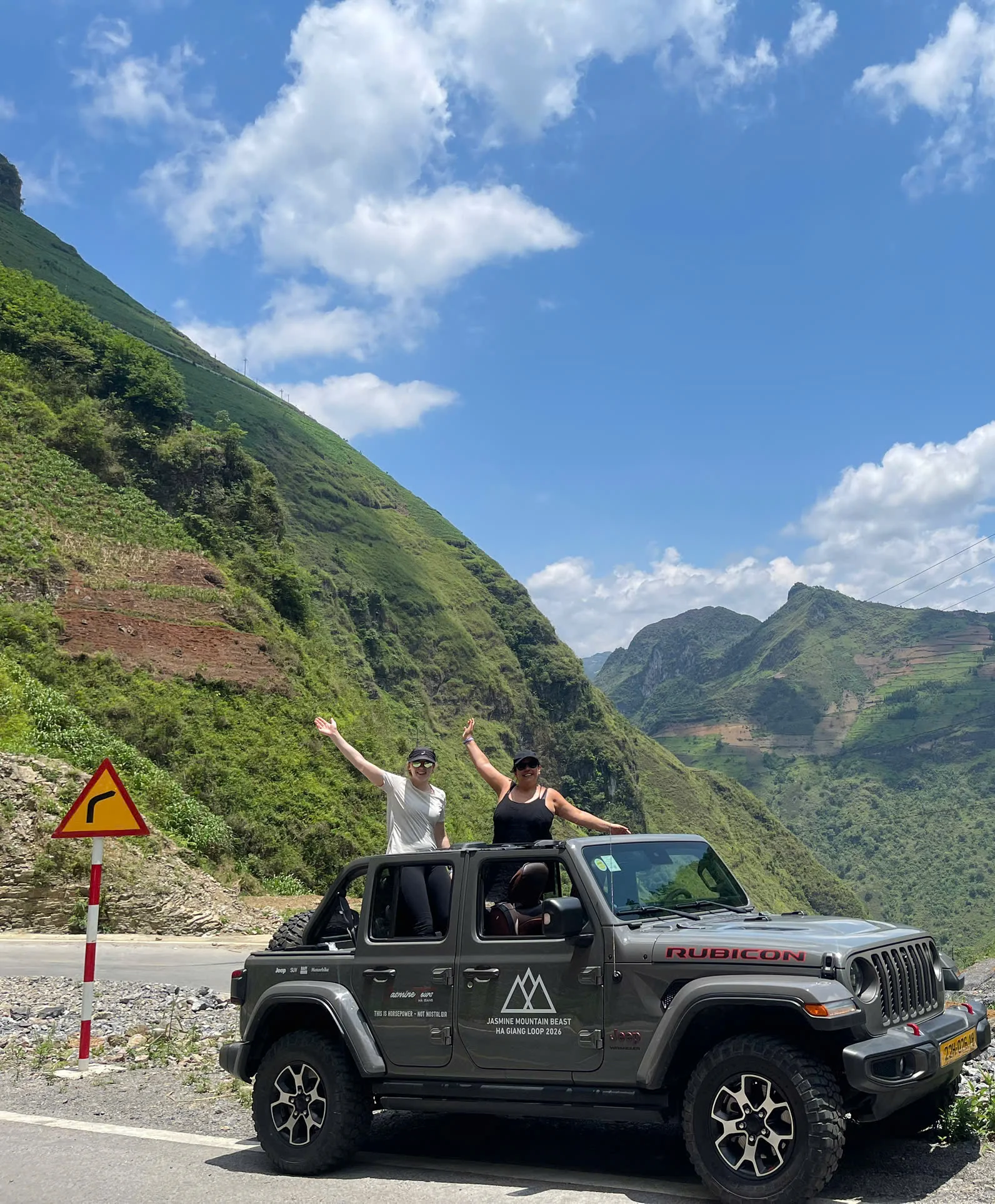
Ask the guides who ride this circuit daily what goes wrong, and you get the same four answers.
Riding a bike you have not learned yet. A lot of people touch a semi-automatic (you change gear with your foot, but there is no clutch lever) or a full manual bike for the first time on the morning they leave Ha Giang city. Then Tham Ma (Thẩm Mã) pass arrives, with hairpin stacked on hairpin and a steep grade, and a left hand that has never worked a clutch under pressure. Be honest with yourself about your skill before you rent, not after.
Weather that turns in minutes. From roughly May to September, sudden downpours flood corners and cut visibility while you are still deciding whether to pull over. From roughly December to February, fog on the high passes can shrink your world to a few metres. Check conditions each morning and build slack into the plan, so that waiting out a storm costs you an hour instead of your trip.
Overconfidence. Some riders treat this like a track. It is not one. The guides who ride these corners every single day ride them slowly, and that is the tell. Out here the speed is set by the road, not by how well you ride at home.
Corn wine and riding after dark. Homestay dinners come with rượu ngô, corn wine, poured warmly and often. Enjoy it, then put the keys away. After dark there are no streetlights, buffalo wander across blind corners, and trucks cut the centre line. Drink or ride, never both, and do not ride at night at all.
Four patterns, every one of them avoidable. Before any of them, though, there is a piece of paper that decides more than most riders realise.
Do you need a licence to ride the Ha Giang Loop?
Yes. This is the part most guides skip, and it is the one that changes what happens to you afterwards.
Vietnam changed its licence classes on 1 January 2025. Under Luật Trật tự, an toàn giao thông đường bộ 2024 (Luật số 36/2024/QH15, Điều 57), class A1 now covers bikes up to 125 cm³ and class A covers anything above that. Almost every guide still online quotes the old 175 cm³ rule, and plenty quote a “50cc” threshold that has not been the test for years. The bikes actually rented for this route sit either side of that 125 cm³ line, so which class you need depends on which bike you are handed.
A licence that Vietnam does not accept is not a paperwork problem, it is an insurance problem. Most travel policies exclude motorbike accidents when the rider was not validly licensed, and that exclusion is usually printed in the policy you already bought. A scraped rental can be paid for. A hospital bill your insurer refuses to touch cannot.
You do not have to take a Vietnamese law citation from a Vietnamese tour operator on trust, which is the point of naming it. If you are British, your own government states the same requirement, including that riding without third-party insurance here is illegal: see the UK Foreign Office travel advice for Vietnam. Most other foreign ministries publish an equivalent page. Read yours before you read mine.
Licence classes: Luật số 36/2024/QH15, Điều 57, in force 1 January 2025, retrieved 2026-08-02. UK FCDO Vietnam travel advice, retrieved 2026-08-02.
That is as far as this article goes on the subject, because it deserves a full answer rather than a paragraph. Read whether you need a licence for the Ha Giang Loop, which cites the decree, gives the actual fine brackets, and explains which international permit your country issues and whether it works here.
What I will not do is tell you that nobody checks. There are traffic police checkpoints on this route, and more importantly, the licence question follows you into the ambulance.
What do the guides here actually do differently?
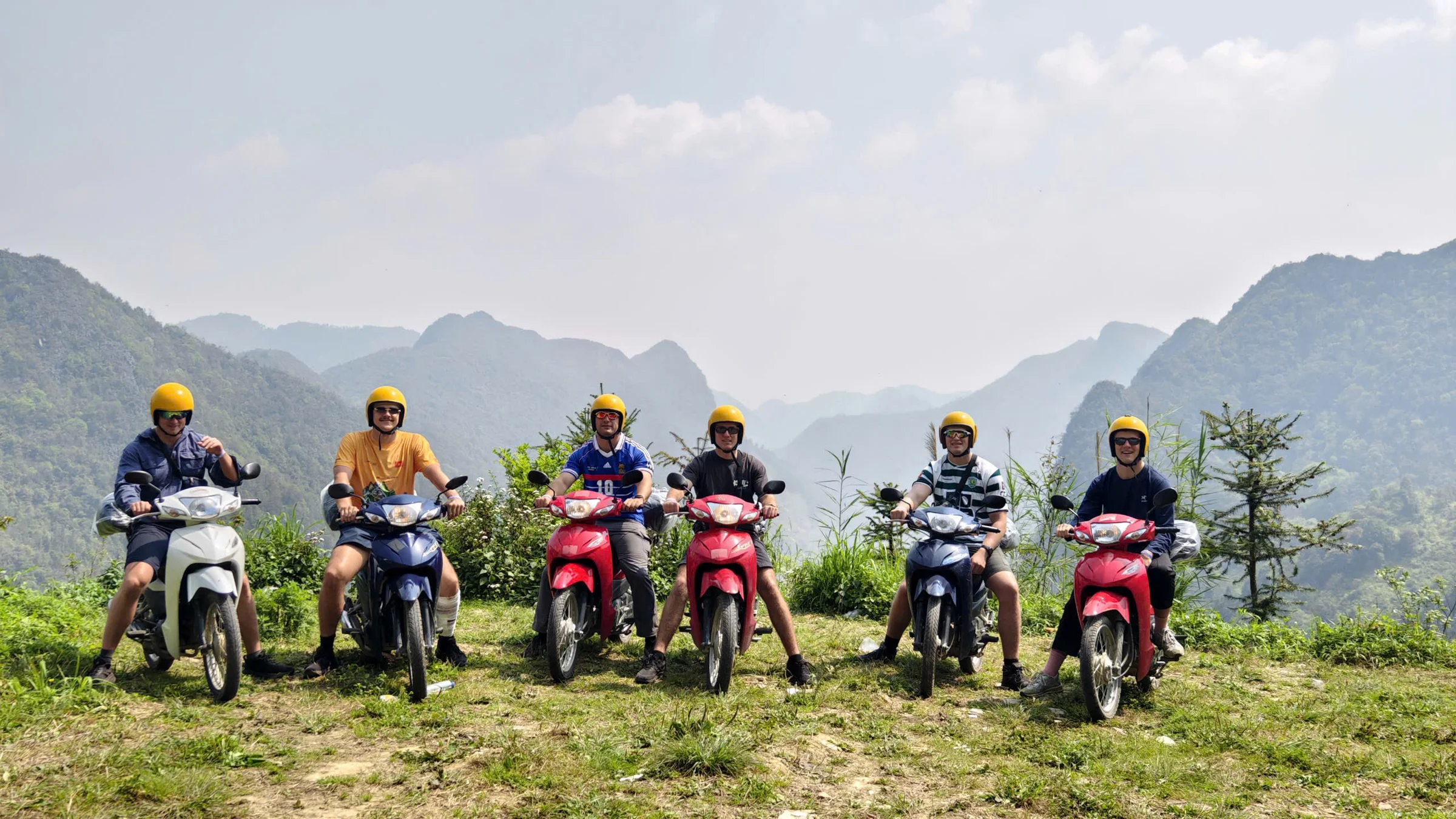
Seven things, and none of them are copied from a safety manual. This is what the guides I know here actually do before the engines start. I am not one of them: I do not guide and I do not ride these routes for a living, so treat this as reported, not as my own riding advice.
- Match the format to the skill you have, not the skill you want. If you have never ridden a manual or semi-automatic bike on mountain roads, the hairpins on Thẩm Mã are a bad classroom. Riding pillion with an easy rider (a licensed local driver; you sit on the back) puts you on exactly the same road with your hands free.
- Wear the gear, even when it is hot. Proper helmet, jacket, gloves, long trousers, closed shoes, every ride. Heat is uncomfortable. Road rash is worse, and it is the injury that turns a good trip into three days in a clinic.
- Ride slowly. More reaction time, better views, more photographs, less exhaustion by evening. There is no cost to this one.
- Take at least three days, ideally four. The riders who get into trouble are usually the ones racing the light to make up time. Four days means you never have to.
- Corn wine or handlebars, never both. Your hosts will pour generously at dinner. Enjoy it and ride the next morning.
- Never ride after dark. No streetlights, free-roaming livestock, trucks cutting corners you cannot see into. Nothing on this route is worth seeing at night from a motorbike.
- Ask a local every morning. Road conditions, weather, construction, animals on the passes. People here know before any app does. Borrow the habit, it costs nothing.
Save 115, Vietnam’s medical emergency number, and your driver’s or guide’s number into your phone before you leave Ha Giang city. Do it while you still have a signal and a free hand.
Self-drive or easy rider: which is safer?
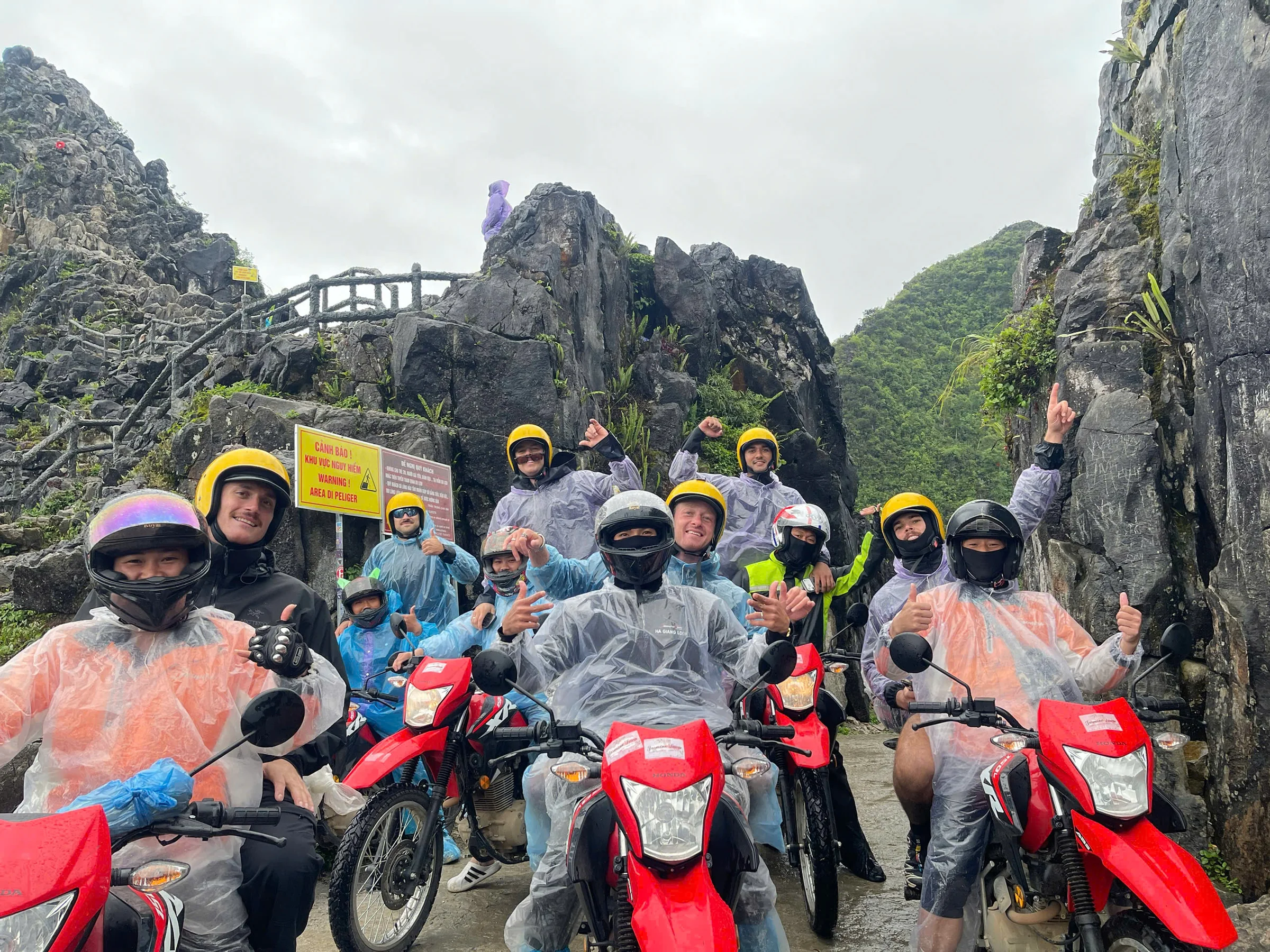
This is the biggest safety choice you will make, bigger than which helmet you buy, and I am only going to cover the safety half of it here.
Riding yourself puts you in charge of a manual bike on mountain passes, and it puts the licence and insurance question squarely on you. Riding pillion with an easy rider moves both of those to a local driver who rides this road for a living. That is the whole safety difference, stated plainly.
Two things worth saying, and the second one costs my business money.
Choosing the back seat is not the beginner option. Some of the most experienced riders we host pick it deliberately, because they would rather watch the mist lift off Ma Pi Leng (Mã Pí Lèng) than stare at the tarmac in front of the wheel.
And a guided tour does not make this road safe. It removes decisions, it puts someone next to you who knows which corner hides a truck, and it means the emergency calls happen in Vietnamese while you catch your breath. Those are real. They are not the same as safety. If you can genuinely ride a manual bike and you hold a licence Vietnam accepts, self-drive is the better trip, and I would rather say that than sell you something you do not need.
The cost side, the comfort side and the actual decision live in the full comparison: self-drive vs easy rider on the Ha Giang Loop.
What should you do if an accident happens?
The riders who know these steps in advance are the calm ones. Fear shrinks when you have a plan.
- Stop and get out of the lane. If you can move safely, get yourself and the bike off the road. Traffic keeps arriving around blind corners.
- Do not move anyone who is seriously injured, unless leaving them where they are is the greater danger.
- Call 115. That is Vietnam’s medical emergency number.
- Call your driver, guide or rental shop straight away. They can speak to the clinic in Vietnamese and they know where the nearest one is.
- Get to a medical facility once it is safe to move.
On that last point, the map is kinder than it looks from a hotel room in Hanoi. There is a provincial hospital in Ha Giang city, and district medical centres in Dong Van, Meo Vac and Yen Minh, which are the main towns on the route. You are never as far from help as these mountains make you feel.
What did two Jasmine Tours guests say about the risk?
These are guests of Jasmine Tours, the company I hold a share in and no longer run. I was not on either trip. For scale, Jasmine Tours took 28,943 guests round this loop during 2025, so two reviews is a very small window onto a very large number. I picked these two on purpose, and neither is a happy quote about scenery.
Joseph Y., United States. Google review, 5 stars, March 2026. Joseph is a Google Local Guide with 301 reviews behind him. He did not ride; he took the Jeep. On the way round he saw a guest from a different group who had been hurt, waiting for an ambulance. He still gave five stars, and this is the line that matters: “The loop and biking have inherent risk. The Jeep mitigated that.” He also wrote, unprompted, “I was not asked or compensated for this review.”
Jerredk. Google review, 5 stars, September 2025. Also a Local Guide, 397 reviews and 2,192 photos. He gave the road a number instead of an adjective: “95% of the roads are very good.” Which means five percent are not, and you should know that before you arrive. He also said “Breakfast was very light.” I am posting the complaint along with the stars, because an operator who only shows you the good lines is telling you something about the lines they are hiding.
Joseph’s review is the one I would read twice if I were you. A guest describing an injury he watched happen, on a page published by the company he is reviewing, is worth more than any safety claim I could write myself.
Both quoted verbatim from public Google reviews of the Jasmine Tours Ha Giang office, 22 Ngõ Phất Lộc, Hoàn Kiếm, Hanoi, retrieved 2026-08-02. Go and read the rest yourself rather than taking my word for either quote: the listing carried 4.9 stars from 1,867 reviews on that date.
One last thing that keeps this road rideable
There is one more thing that keeps this road usable, and it has nothing to do with helmets.
It has nothing to do with helmets. Bare hillsides erode, and erosion is what cracks and crumbles the tarmac under your wheels, then puts the loose gravel on it that takes your front wheel away on a bend. Several operators here run tree-planting schemes with local families along the route, and whatever else those schemes are, the trees hold soil that would otherwise end up on the road surface you are riding.
I will be straight about those schemes, including the one run by the company I hold a share in: they are also marketing. They get photographed, and they make people feel good about booking. Both things are true at once, and the hillside does not care which. My own work in the province is separate from any of them, and when I write about it here it will be under its own heading, not folded into road advice.
Ha Giang Loop safety: frequently asked questions
Is the Ha Giang Loop dangerous?
It carries real risk, but rarely by surprise. The same four causes come up again and again: riding a manual bike you have not learned, weather that turns fast, overconfidence, and alcohol or night riding. There is no reliable public accident count for this route, and any page quoting one is guessing.
Can a complete beginner do the Ha Giang Loop?
Yes, on the back of an easy rider’s bike or in a Jeep. You get every pass and every view without the handlebars. Riding yourself only makes sense if you are already comfortable on a manual bike and hold a licence Vietnam accepts.
What is the most common cause of accidents here?
Inexperience on a manual or semi-automatic bike, usually within the first day. The steep hairpins on Thẩm Mã pass arrive early and they test whatever skill you brought with you.
How many days should I allow?
Three at minimum, four is safer. Rushed riders are the ones still on the road at dusk, which is when this route forgives the least.
Are there police checkpoints on the Loop?
Yes. Riding without a licence Vietnam accepts risks a fine and an impounded bike, and it is likely to void the travel insurance you already paid for. The licence guide covers the specifics.
Is a guided tour actually safer?
It removes decisions rather than removing risk. You get a morning briefing, maintained bikes, someone who knows the road, and emergency help one call away in Vietnamese. You are still on the same bike on the same pass. If you can ride and you have the right licence, self-drive is a legitimate choice and often the better trip.
A note on method: this guide deliberately contains no accident statistic and no price. There is no reliable public count of accidents on this route, and prices move fast enough that an undated one is worse than none. The legal points cite Vietnamese law rather than another travel blog, because the operator pages competing for this search contradict each other on whether Vietnam recognises an international permit at all.
Reading about accidents is not fear. It is preparation. You searched for what goes wrong, and that is the reason you will most likely come home talking about the view instead.
Written by Jasmine (Thuy Bui), born and raised in Ha Giang. This site sells nothing and I no longer run tours. I co-founded Jasmine Ha Giang, a licensed local tour operator (Business Registration Certificate #5100503221, issued 11 March 2025), and I still hold a share in it; the team there operates it without me. My work now is free advice for travellers and social projects in the province.
Leave a Reply