Key Takeaways
- It depends entirely on what you mean by “no experience”, and there are three very different versions of that.
- If you have never ridden any powered two-wheeler at all, learning on this road is a bad idea, and I will not soften that.
- If you have ridden a scooter on flat roads before, you are in the group where the honest answer is “probably, with conditions”.
- Your licence changes the question before your skill does, because it decides whether your insurance pays anything at all.
- Riding pillion with an easy rider is not the beginner’s consolation prize. It is a legitimate way to see the same road, chosen by plenty of experienced riders.
Disclosure, before anything else
This site sells you nothing. No tours, no bookings, no affiliate links. I do still own a share of a Ha Giang tour company I no longer run, so I benefit if you book with them. That is worth holding in mind on this page in particular, because one of the answers below sends you towards a guided option, and you should be able to see my interest while you weigh it.
Most pages that answer this question say yes. Some of them say “anyone can do it”.
I am not going to say that, because it is not true and because people get hurt on the difference. What I can do is split the question properly, which nobody seems to bother with.
What do you actually mean by “no experience”?
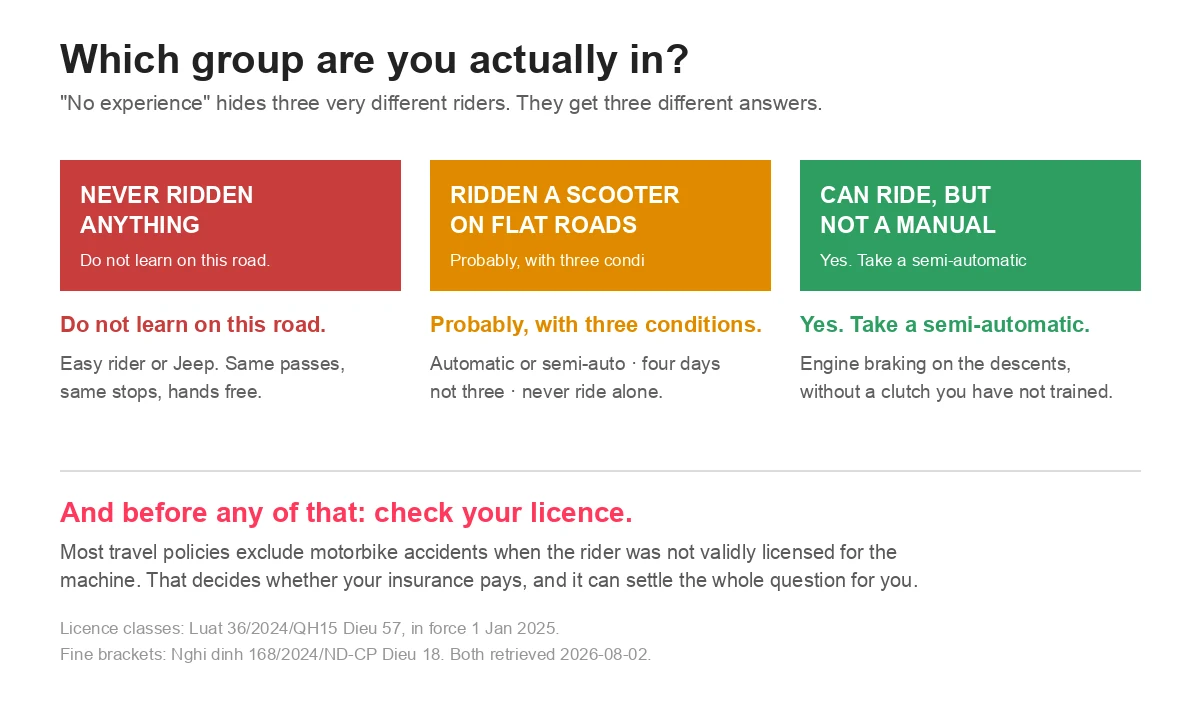
There are three groups hiding inside that phrase, and they get three different answers.
Group one: you have never ridden anything. No scooter, no motorbike, not even a rented one on a beach holiday. Your only two-wheel experience is a bicycle.
Group two: you have ridden an automatic scooter. A week in Bali, a few days in Thailand, a rental in Da Nang. Flat roads, light traffic, twist and go.
Group three: you can ride, but not a manual. You are comfortable on two wheels and confident in traffic, but you have never used a clutch or changed gear with your foot.
Almost every guide answers as though everyone reading is in group two or three. The honest answers are quite different.
What if you have never ridden anything at all?
Do not learn on this road.
I want to be exact about why, because “it’s dangerous” is a lazy answer that helps nobody.
The Ha Giang Loop is not technically difficult riding. What it is, is unforgiving of small mistakes. On a flat road, stalling in the wrong place, grabbing the front brake, or misjudging a corner costs you a wobble and some embarrassment. On a mountain road with a drop on one side, blind bends, and trucks that use the middle of the road, the same small mistake has nowhere to go.
Learning to ride means making those mistakes. That is what learning is. The question is only where you make them, and the answer should not be a pass at altitude on day one of a trip you saved for.
If somebody tells you they will teach you in the car park before you set off, be very careful. Twenty minutes in a flat car park does not prepare you for Thẩm Mã pass, and a shop that says it will is telling you what you want to hear because it wants to rent you a bike.
What to do instead: ride pillion with an easy rider, or take a Jeep. You get the same road, the same passes, the same stops, and your hands free for a camera. More on why that is not a downgrade below.
If you have ridden an automatic scooter
This is where the honest answer becomes “probably, with conditions”. Most people asking this question are in this group.
Three conditions, and I would not drop any of them.
- Rent an automatic or a semi-automatic, not a manual. Do not decide to learn the clutch here as well as the road. One new thing at a time.
- Give yourself four days, not three. The riders who get into trouble are usually the ones racing daylight to make up time. Four days means you can stop when you want to.
- Ride with somebody, not alone. Not for company. Because if something happens on an empty stretch, the difference between one rider and two is enormous.
If you cannot meet all three, that is useful information rather than a failure. It means the conditions that would make this work are not available on this trip.
If you can ride but not a manual
You are the group with the most freedom, and the one most likely to make an avoidable mistake, because confidence transfers and clutch control does not.
The realistic option is a semi-automatic. You change gear with your foot, but there is no clutch lever, so you keep engine braking on the descents without having to coordinate a hand you have never trained. Engine braking matters more here than power does, and that is the part people underestimate.
If you want to ride a full manual, learn it somewhere flat first, on another trip. Not on a road where the first pass arrives within the hour.
Which specific bike suits which rider is a longer question and it gets its own article. The rental price list shows what each type costs, including the insurance line that most quotes leave out.
What matters more than your skill?
Here is the part that catches people, and it has nothing to do with how well you ride.
Your licence decides whether your insurance pays. Most travel policies exclude motorbike accidents when the rider was not validly licensed for the machine, and that exclusion is usually printed in the policy you already bought.
Vietnam changed its licence classes on 1 January 2025. Under Luật số 36/2024/QH15, Điều 57 (retrieved 2026-08-02), class A1 covers up to 125 cm³ and class A covers anything above it. British riders can see the same requirement stated by their own government in the UK Foreign Office travel advice for Vietnam (retrieved 2026-08-02).
There is a second consequence besides the insurance one. Riding without a licence Vietnam accepts also carries a fine, and it is not a token amount: Nghị định 168/2024/NĐ-CP, Điều 18 sets two brackets depending on engine size, and the larger one applies to most of the bikes rented for this route (retrieved 2026-08-02).
So the order of questions is not “can I handle it, and do I need a licence”. It is the other way round. Sort the licence first, because it decides what happens afterwards. The full version is in whether you need a licence for the Ha Giang Loop.
Open your travel insurance policy and search it for the word “motorcycle” before you book anything. Two minutes now, and you will know whether the rest of this decision is even yours to make.
Riding pillion is not the beginner’s option
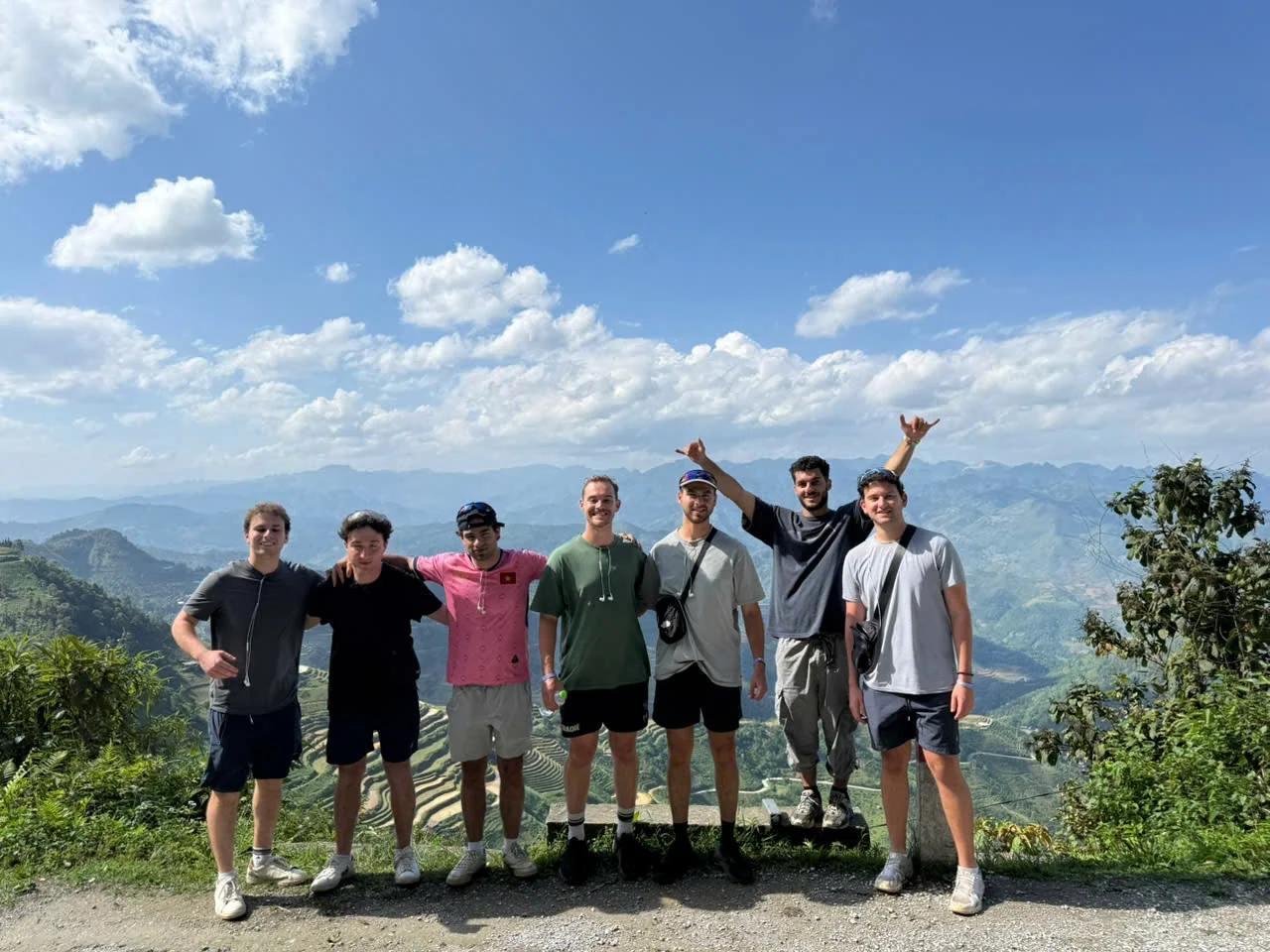
I want to push back on something the whole industry, mine included, has trained people to believe.
Choosing an easy rider is treated as the option you take when you are not good enough. That framing is wrong, and it pushes nervous people onto bikes they should not be on, because nobody wants to feel like they took the lesser trip.
You are on the same road. You stop at the same places. You see the same passes. What changes is that somebody who rides this route every week is doing the difficult part, and your attention is free for the thing you came for.
Some of the most experienced riders who come here choose the back seat deliberately, because they would rather watch the mist lift off Mã Pí Lèng than watch the tarmac in front of their wheel. That is not the timid choice. The comparison in full is in self-drive versus easy rider.
A note on method: I am not a riding instructor and I do not claim to be. What I have is years of watching which travellers arrive here confident and leave fine, and which ones arrive confident and do not. The licence and insurance points cite Vietnamese law and a foreign ministry rather than any operator, including the one I hold a share in.
So what should you actually do?

- Never ridden anything: take an easy rider or a Jeep. Learn to ride at home, come back and self-drive next time.
- Ridden a scooter on flat roads: self-drive is reasonable on an automatic or semi-automatic, over four days, with somebody else.
- Confident rider, no clutch: semi-automatic, and do not treat the descents as the easy part.
- No licence Vietnam accepts: easy rider, whatever your skill. This is an insurance decision, not a driving one.
- Not sure: assume the more cautious answer. Nobody has ever regretted taking the safer option on this road. The reverse is not true.
Common questions
Can a complete beginner ride the Ha Giang Loop?
If you have never ridden any powered two-wheeler, this is not the place to learn. The riding is not technically hard, but it is unforgiving of the small mistakes that learning necessarily involves. Ride pillion with an easy rider or take a Jeep instead.
Is a week on a scooter in Thailand enough experience?
Usually yes, with three conditions: rent an automatic or semi-automatic rather than a manual, allow four days rather than three, and do not ride alone. If you cannot meet all three, reconsider.
Should I learn to ride a manual bike in Ha Giang?
No. Learn the clutch somewhere flat on a different trip. A semi-automatic gives you engine braking for the descents without asking you to coordinate a skill you have never trained, which is the part that matters here.
Does my riding experience matter more than my licence?
No. Your licence decides whether your travel insurance pays out if something goes wrong, and most policies exclude riders who were not validly licensed. Sort that question first, because it can settle the whole decision.
Is riding pillion boring compared to driving yourself?
Plenty of experienced riders choose it on purpose, because driving a mountain road means watching the road rather than the view. You get the same passes, the same stops and the same trip, with your attention free.
What if the rental shop says they will teach me?
Be careful. A short lesson in a flat car park does not prepare anyone for a mountain pass, and a shop that tells you it does has an interest in renting you the bike. Judge the offer by whether it would convince you if nobody were making money from your answer.
If you are still unsure after reading this, that uncertainty is itself the answer, and it points at the back seat. You can always come back and ride it yourself once you have learned somewhere flatter.
Written by Jasmine (Thuy Bui), born and raised in Ha Giang. This site sells nothing and carries no affiliate links. I co-founded Jasmine Ha Giang, a licensed local tour operator, and I still hold a share in it; the team there operates it without me. My work now is free advice for travellers and social projects in the province.
Leave a Reply