Yes. To ride your own motorbike on the Ha Giang Loop legally, you need an International Driving Permit issued under the 1968 UN Convention, carried together with the home licence it was issued against, in a category that covers your bike. Most bikes rented here sit above 125cc, which is a stricter category than travellers expect.
Key Takeaways
- Vietnamese law names one instrument: the 1968 Convention International Driving Permit. Carry it with your home licence, never instead of it.
- On 1 January 2025 the ceiling of licence class A1 dropped from 175cc to 125cc. The bikes rented on the Loop are just under 150cc, which is still the wrong side of that line.
- That puts an unlicensed rider in the 6,000,000 to 8,000,000 VND fine bracket, not the 2,000,000 to 4,000,000 one most guides quote. Both checked August 2026.
- A rental shop that asks for nothing isn’t granting you permission. The shop isn’t the checkpoint.
- Booking a guided tour doesn’t make an unlicensed rider legal. Not ours, not anyone’s.
Disclosure, before any numbers
This site sells you nothing: no tours, no bookings, no affiliate links. I do still own a share of Jasmine Tours, a motorbike and Jeep operator here in Ha Giang, which I co-founded and no longer run. So I benefit if you book with them, and you should know that before you read a legal page written by me.
That is exactly why this page is written the way it is. The section that matters most to you is the one where I explain that booking a guided tour does not solve this problem for you.
I was born in Ha Giang. Almost everyone who writes to me before a trip asks the same questions in the same order, and the third one is always the licence. It’s also the question the internet answers worst. Every page on Google’s first result page in August 2026 was published by someone selling something on this route. Not one was a government or a legal source, and they contradict each other on whether Vietnam recognises a foreign permit at all.
So this article does something the others don’t. It quotes the law.
Do you need a licence for the Ha Giang Loop?
You do, and it’s two documents rather than one.
Vietnamese law recognises an International Driving Permit, usually shortened to IDP, issued under the 1968 United Nations Convention on Road Traffic. It also requires you to carry the national driving licence that permit was issued against, in a category that covers the machine you’re on. Missing either half is a separate, named offence.
The UK Foreign Office puts it in one sentence: you need “both the 1968 version of the international driving permit and your UK driving licence with you whilst driving a car or motorbike in Vietnam” (FCDO Vietnam travel advice, retrieved 2 August 2026). The Vietnamese decree says the same thing from the other direction, by making it a finable offence to hold the permit without the licence.
| What changed, or what it costs | Figure | Source |
|---|---|---|
| Licence class A1 ceiling, before and after 1 January 2025 | 175cc → 125cc | Luật 36/2024/QH15, Điều 57 |
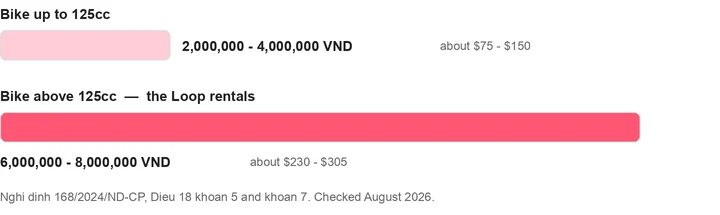
| No valid licence, bike over 125cc | 6,000,000 to 8,000,000 VND (about $230 to $310) | Nghị định 168/2024/NĐ-CP, Điều 18 khoản 7 |
| No valid licence, bike up to 125cc | 2,000,000 to 4,000,000 VND (about $75 to $155) | Nghị định 168/2024/NĐ-CP, Điều 18 khoản 5 |
Licence classes from Luật Trật tự, an toàn giao thông đường bộ 2024 (Luật số 36/2024/QH15, Điều 57), passed June 2024. Fines from Nghị định 168/2024/NĐ-CP, Điều 18, signed 26 December 2024. Both in force from 1 January 2025; both retrieved 2 August 2026. All VND amounts were checked in August 2026 and converted at roughly 26,000 VND to the US dollar.
Step 1: Check what class of bike you’ll actually be riding
Before you book anything, you need three facts about your trip: the engine size of the bike you’ll be given, which convention your country’s permit is issued under, and which categories your own licence carries. This step settles the first one.
By the end of it you’ll know which of two fine brackets you’re standing in, because that’s decided by engine size and nothing else.
On 1 January 2025 Vietnam replaced its road traffic law. The new statute redrew the motorbike licence classes, and it moved the line most travel advice is still built on.
- Class A1 now covers two-wheel motorbikes up to 125cc, or an electric motor up to 11kW.
- Class A covers anything above that.
- Under the previous law, in force until the end of 2024, A1 ran from 50cc up to under 175cc.
Now look at what’s actually parked outside the shops in Ha Giang city, as of August 2026. Ask for the bike most people are handed for the Loop and you’ll usually get a 150cc-class machine. One of the most common is the Honda Winner R, a manual bike you shift with your foot rather than a twist-and-go scooter. Honda Vietnam’s own specification sheet puts it at 149.2cc (retrieved 2 August 2026). It was sold as the Winner X until recently, which is the name you will still see on rental boards. Either way it is above 125cc. Under the old rule an A1 entitlement covered it comfortably. Since January 2025 it doesn’t.
Check the engine size on the registration document before you agree to anything, not the sticker on the fairing. If the shop can’t show you the registration, that’s your answer about the shop.

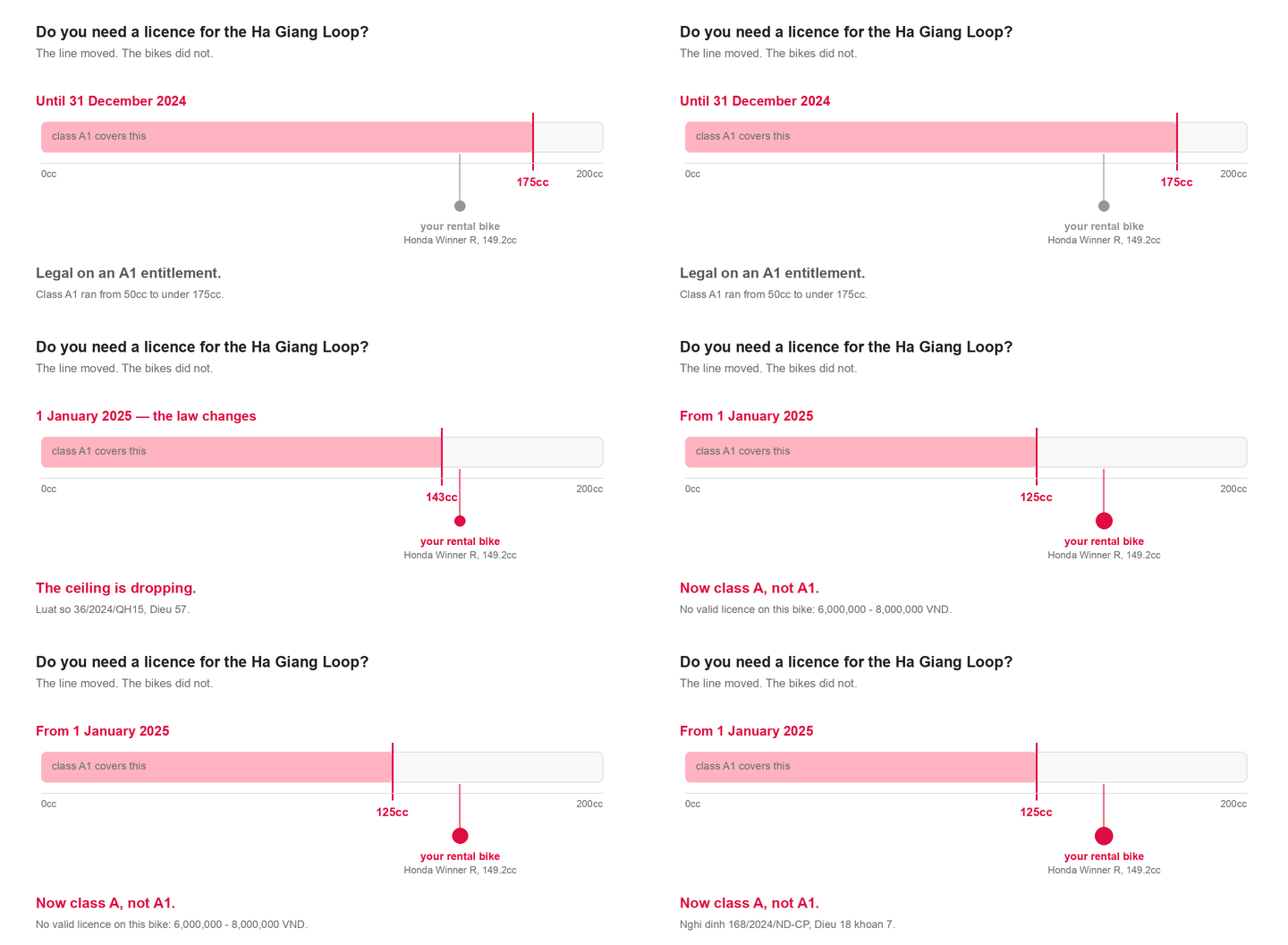
Two things moved on the same day, and they moved together. The Law dropped the A1 ceiling to 125cc, and the new decree set its own fine brackets on that same 125cc line. A 150cc bike crossed both at once.
That’s why the standard advice has quietly gone stale. Guides written before 2025, and plenty written after, still repeat the 175cc figure. A rider who reads that, checks their A1 category and rides off on a 150cc bike isn’t slightly wrong. They’re in the top bracket, at two to three times the fine they were expecting.
Checkpoint: you should now be able to say the engine size of your bike out loud, and know whether it’s above or below 125cc.
Step 2: Find out which permit your country issues, 1968 or 1949
By the end of this step you’ll know whether the permit your home authority sells you is the one Vietnamese law names. Two international permit systems are in circulation and they aren’t interchangeable.
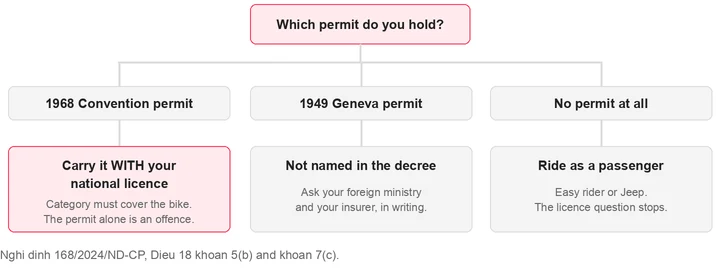
The decree names one: a permit issued by countries party to the 1968 UN Convention on Road Traffic. The older 1949 Geneva Convention permit isn’t mentioned anywhere in the clauses that govern this, and the law makes no provision for it.
- Ask your issuing authority, in writing, which convention your permit is issued under. Not “is it valid in Vietnam”, which they won’t answer. The convention year is a fact they must know.
- Some countries issue more than one type, for different destinations. Getting the wrong one back is common.
- Check the category printed on the permit. A car category doesn’t cover a motorbike.
A note on method: I’m telling you what the Vietnamese decree names, and stopping there. The United Nations treaty register lists 91 parties to the 1968 Convention, Vietnam among them since 20 August 2014, and the United States, Canada and Australia are not on that list (retrieved 2 August 2026). Those three issue permits under the older 1949 Geneva Convention instead, which the decree does not mention. I’m not going to translate that silence into a promise about your paperwork, in either direction. Ask your own foreign ministry directly, then ask your insurer in writing, and trust those two answers over any blog including this one.
Checkpoint: you should now know the convention year and the vehicle category printed on your permit, or know that you don’t have one.
Step 3: Get the permit before you fly, in the right category
By the end of this step you’ll either be holding a valid 1968 permit with a motorcycle category on it, or you’ll know that you aren’t going to have one, which is useful information in itself.
An IDP is issued by an authority in the country that issued your licence. It’s a translation of that licence, not a licence in its own right. That has two consequences travellers routinely discover too late:
- You can’t pick one up as a tourist after you land. It has to exist before you fly.
- It only carries the categories your home licence already has. If your licence has no motorcycle entitlement, the permit won’t invent one, and a car-only permit is no help on a motorbike.
If your home motorcycle entitlement is restricted to small machines, that restriction travels with you. Read Step 1 again before you assume it covers a 150cc bike.
One honest limit here. The decree penalises a licence “not appropriate to the vehicle being driven”, and it does not publish a table mapping foreign categories onto Vietnamese ones. So read it conservatively: if your home entitlement stops below 150cc, assume Vietnam reads it the same way rather than hoping it doesn’t.
Checkpoint: you’re holding a 1968 permit that shows a motorcycle category, alongside the licence it was issued against.
Step 4: Carry both documents, every day you ride
By the end of this step you’ll understand why leaving your home licence in the hostel safe is its own offence, with its own fine, even when your permit is perfect.
The decree is explicit. Holding a 1968 permit “but not carrying the national driving licence appropriate to the type of vehicle permitted” is listed as a finable act in its own right, at both engine-size brackets. This is the detail no page I found on Google’s first result page in August 2026 mentions, and it catches careful people. They got the right permit, treated it as the document, and locked the licence away for safekeeping.
Carry both. Photograph both. Keep the photographs somewhere you can reach without a signal, because you won’t have one for much of the route between Dong Van (Đồng Văn) and Meo Vac (Mèo Vạc).
One more thing, straight from the FCDO: “Do not use your passport as a deposit for hiring vehicles or as a guarantee you will pay a fine for a traffic offence.” Shops here will ask. You’re allowed to say no and offer cash instead.
Checkpoint: both documents are physically on you, not in your room, every day you ride.
What happens if you’re stopped without one?
The fine depends on the bike, not on your intentions, and for the machines rented on this route it’s the higher number.
Under Điều 18 of Nghị định 168/2024/NĐ-CP, in force since 1 January 2025, riding without a valid licence costs 2,000,000 to 4,000,000 VND (about $75 to $155, checked August 2026) on a bike up to 125cc, and 6,000,000 to 8,000,000 VND (about $230 to $310, checked August 2026) on a bike above 125cc. The same clause covers a licence that’s expired, one not issued by a competent authority, and, at the higher bracket, simply holding a licence that doesn’t match the vehicle you’re on.
There’s a smaller one people forget. Riding without a valid compulsory civil liability insurance certificate, which is a Vietnamese document and not your travel insurance, costs 200,000 to 300,000 VND (about $8 to $12, checked August 2026, under the same article). Ask the rental shop to show you the certificate for that specific bike, and photograph it.
Now the honest part. Plenty of riders finish the Loop and tell me nobody ever asked them for a document. That’s a real report and I’m not going to pretend otherwise. It’s also not a plan. It tells you about enforcement on the days those particular people rode, and it tells you nothing about your position the moment something goes wrong, which is the only moment any of this actually matters.
Does your travel insurance still cover you?
Read your policy, because this is where an affordable mistake becomes an expensive one.
Insurers generally require you to be riding legally in the country you’re riding in, which loops straight back to the documents above. The FCDO states plainly that “it is illegal to drive without third-party insurance” in Vietnam. If you aren’t licensed to be on the bike, assume a claim can be refused, and verify that assumption with your own insurer in writing before you go rather than after. A single medical evacuation from this province costs more than every fine on this page combined.
What if you can’t get a valid 1968 permit?
Then you have three honest options, and riding anyway isn’t one of them.
Before the options, the sentence the UK Foreign Office puts above all of this: “Do not hire a motorbike if you’re not an experienced rider.” It also records that “travelling by motorbike in Vietnam is much riskier than in the UK. Motorbike accidents are common and have killed and injured British nationals.” That is a government telling you not to rent, and it applies whatever your paperwork says.
Ride as a passenger. Sit on the back with an easy rider, meaning a local driver who rides while you ride pillion. You aren’t operating the vehicle, so the licence question stops applying to you. You still see the same road.
Take a vehicle you aren’t driving. A Jeep or a car with a driver puts the legal burden where it belongs, on a professional who’s licensed for it.
Change the trip. Come back with the right paperwork. The passes will still be here.
Two of those three options, easy rider and Jeep, are things my team sells. So treat that list as a recommendation with my thumb on the scale, and apply the same test to us that I gave you for the rental shop: ask any operator to show you the driver’s licence card, and check it says hạng A rather than hạng A1 if the bike is over 125cc. An operator who won’t show you that has told you something. Separately, your own travel policy may still exclude riding pillion on a motorbike at all, so check that line before you assume being a passenger solves your insurance too.
And here’s the part my team would rather I left out. Booking a guided tour doesn’t make an unlicensed rider legal. If you ride your own bike on any operator’s trip, ours included, without a licence Vietnamese law recognises, you’re in exactly the same position as an independent rider who never spoke to a company. Having a guide beside you changes nothing about your paperwork and nothing about your insurance. The only version where the licence question genuinely stops applying is the one where you aren’t the person driving.
Any operator who lets you believe otherwise is selling you a feeling, not a legal position.
What do most riders get wrong?
1. Treating the rental shop as the authority. Most shops here will hand you a bike without asking to see anything. That’s a commercial decision about their risk, not a legal ruling about yours. The shop doesn’t write the fine.
2. Carrying the permit and leaving the licence behind. Covered in Step 4. It’s a named offence, it has its own fine, and it happens to the most organised travellers.
3. Using the 175cc number. It was correct until 31 December 2024 and it’s wrong now. If a guide quotes 175cc, it hasn’t been updated since the law changed, and you should discount everything else on the page too.
4. Assuming the small fine is the fine. The 2,000,000 to 4,000,000 VND bracket (checked August 2026) gets quoted almost everywhere, because it’s the first one listed in the clause. It’s the bracket for bikes up to 125cc, and not the bracket for the bike you’re about to rent.
What does getting it right look like?
You land with a 1968 permit showing a motorcycle category, and the licence it was issued against. You know your bike’s engine size before you agree to anything. You photograph its compulsory insurance certificate. You keep both documents on your body, not in your room. You decline politely when someone asks for your passport as a deposit.
That’s the whole procedure. One form, a few weeks of lead time at home, and it removes the reason insurers most often give for refusing. It is not a guarantee. Plenty of travel policies exclude motorbikes outright, or above a certain engine size, whatever licence you hold. Ask yours which.
Frequently asked questions
Do I need a licence for the Ha Giang Loop if I’m only a passenger?
No. The licence requirement applies to the person operating the vehicle. If you ride pillion behind an easy rider, or sit in a Jeep with a driver, you don’t need a permit of any kind. Your own travel policy may still exclude riding pillion on a motorbike, so check that separately. This is the standard route for travellers who can’t get a valid 1968 permit in time.
Can I get an International Driving Permit after I arrive in Vietnam?
Not as a tourist. An IDP is issued in the country that issued your driving licence, and it has to be arranged before you travel. Any offer to sell you one locally should be treated with suspicion.
What is the fine for riding without a licence in Vietnam?
Under Điều 18 of Nghị định 168/2024/NĐ-CP, in force since 1 January 2025, it’s 2,000,000 to 4,000,000 VND for a bike up to 125cc and 6,000,000 to 8,000,000 VND for a bike above 125cc, both checked August 2026. Most bikes rented for the Loop fall into the second bracket.
Do the police actually check on the Ha Giang Loop?
Some riders are asked and some finish the route untouched. Enforcement isn’t the useful question, because the documents matter most at the moment of an accident or an insurance claim, not at a routine stop. Plan for the claim, not for the odds of being waved down.
My licence covers 125cc bikes. Can I rent a 150cc for the Loop?
Not legally. Since 1 January 2025 anything above 125cc sits in class A rather than A1, and riding a bike your licence category doesn’t cover is itself a finable offence at the higher bracket. Ask the shop for a bike at or below 125cc, or ride as a passenger.
Is travel insurance enough on its own?
No, and it’s a different thing from the compulsory Vietnamese civil liability certificate that belongs to the bike. Your travel policy will usually require you to be riding legally, so it tends to depend on the documents above rather than replace them. Confirm your own position with your insurer in writing before you travel.
What should you do before you book?
Get the 1968 permit before you fly, with a motorcycle category on it, or plan the trip as a passenger. There’s no third version that’s both legal and honest, and anyone telling you otherwise isn’t the person who’ll be dealing with your insurer.
If you’re now working out what the rest of the trip costs, the full Ha Giang Loop cost breakdown covers the bike, the fuel, the homestays and the fees people forget.
Leave a Reply