Key Takeaways
- There is no best month. There is a trade-off in every month, and the right one depends on whether you would rather be wet, cold, or in a crowd.

- The wet half of the year runs roughly May to late September. It is also the hot half and the cloudy half. Those three things move together here.
- October to April is drier and clearer. It is also colder, and the cold on the high passes surprises people more than the rain does.
- Rain rarely cancels a day. Fog does. A wet road you can ride slowly; a pass you cannot see across, you wait out.
- Whatever month you pick, the plan is the same: build a spare half day into the route, and check the sky each morning before you ride.
Disclosure, before anything else
This site sells you nothing. No tours, no bookings, no affiliate links. I do still own a share of a Ha Giang tour company that I co-founded and no longer run, so I benefit if you book with them. I am saying it here because a page with nothing to sell reads as neutral, and that is exactly when a stake you cannot see matters most. Nothing below is written to push you into a season that suits an operator’s calendar.
Most weather pages about this province do the same thing. They pick October and November, call them perfect, and show you a photograph of a blue sky. I understand why. Those months are lovely, and a blue sky sells.
The problem is that people read that, book October, and then arrive to find fog sitting on Ma Pi Leng (Mã Pí Lèng) for two days, at which point they feel cheated when really they were only ever told half the story.
So here is the whole year, month by month, including what each part of it costs you rather than only what it offers.
What is the weather like in Ha Giang?
Ha Giang (Hà Giang) has one wet half and one dry half, and almost everything else follows from that.
The wetter season runs roughly from early May to late September, when there is a better than one in three chance of any given day being a wet one. The drier stretch is the rest of the year, late September through to early May.
Seasonal ranges and figures throughout this article come from Weather Spark’s long-term averages for Thành Phố Hà Giang, retrieved 2026-08-02. Where I do not have a published figure for a specific month, I say so rather than filling the gap.
Here is the part most guides skip. The wet season, the hot season and the cloudy season are almost the same five months. They are not separate things you can dodge one at a time. Ride in June and you get all three together: heat, rain, and a sky you cannot see the mountains through.
The reverse is also true, and it is the better trade. The dry half is also the clear half. December is the clearest month of the year, sitting clear or partly cloudy about two thirds of the time. July is the cloudiest, overcast or mostly cloudy roughly seven days in eight.
When is the rainy season in Ha Giang?
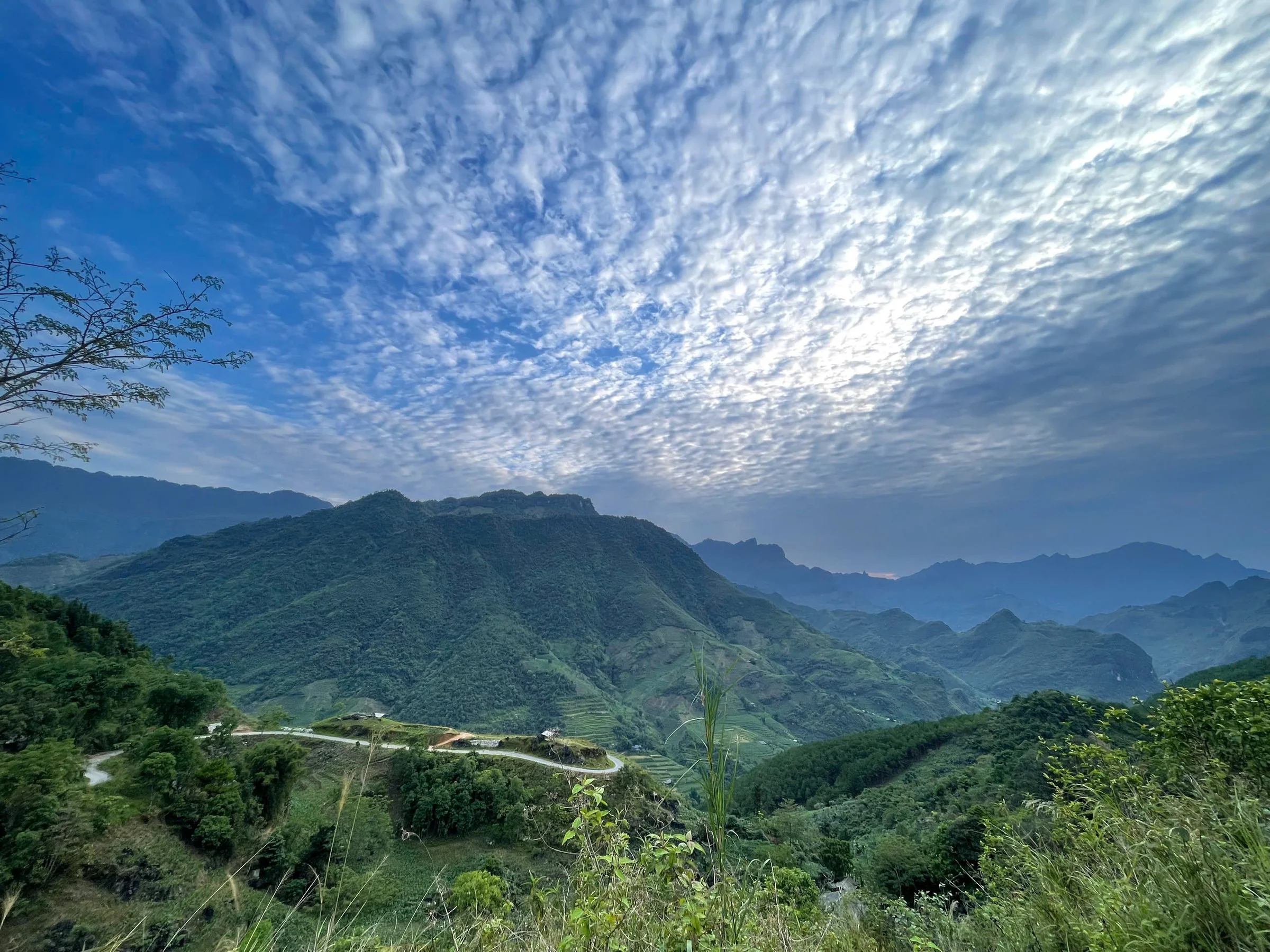
Roughly early May to late September, and July is the peak. July alone averages about 188 mm of rain. February, at the other end, averages about 10 mm. That is not a small difference in degree, it is a different climate.
Rain here does not usually look like the washout that figure suggests, though. It arrives as a heavy hour, then a break, then another heavy hour, which means you generally lose an afternoon rather than losing the trip.
What you should actually plan for:
Wrap your bag before you leave, not when it starts. Nearly everyone learns this on day one. A dry bag or a plastic sack over your luggage costs almost nothing and saves three days of damp clothes.
Buy the poncho locally. They sell them everywhere in Ha Giang city for a few thousand dong, they fit over you and the bike, and they work better than the jacket you brought.
Slow down for the first ten minutes of any rain. That is when oil lifts off the tarmac and the road is at its most slippery. After that it washes clear.
Build one spare half day into a three-day route. If the weather takes an afternoon, you lose the spare instead of losing a pass you came here to see.
Is it cold in Ha Giang? Colder than people expect
This is the part of the year that catches travellers out far more often than the rain does, and it catches them out for a reason worth explaining.
The cold stretch runs roughly from early December to mid February, when daily highs sit below about 22°C. January is the coldest month, with an average low near 13°C and a high near 20°C.
Those numbers do not sound alarming, and in Ha Giang city they are not. The problem is that you will not spend the day in Ha Giang city. You will spend it a few hundred metres higher, moving at 40 km/h, in wind, possibly damp. A 13°C morning becomes something else entirely on a bike on Ma Pí Lèng, and people who packed for “Vietnam” arrive with a t-shirt and a rain jacket.
If you come between December and February, bring the layers and gloves you would use for an autumn morning at home, because carrying them costs you almost nothing while not having them costs you a genuinely miserable morning.
How hot does it get, and does the heat matter on a bike?
The hot season runs roughly from late April to late September, with average daily highs above about 31°C. June is the hottest month, averaging a high near 33°C and a low near 26°C.
Heat on a motorbike is easier than heat on foot because you make your own wind, so the trouble is not the riding itself but what the temperature does to a full-face helmet in slow traffic, and what it does to you the moment you stop moving. Drink more water than you think you need, and take the shade breaks even when you feel fine.
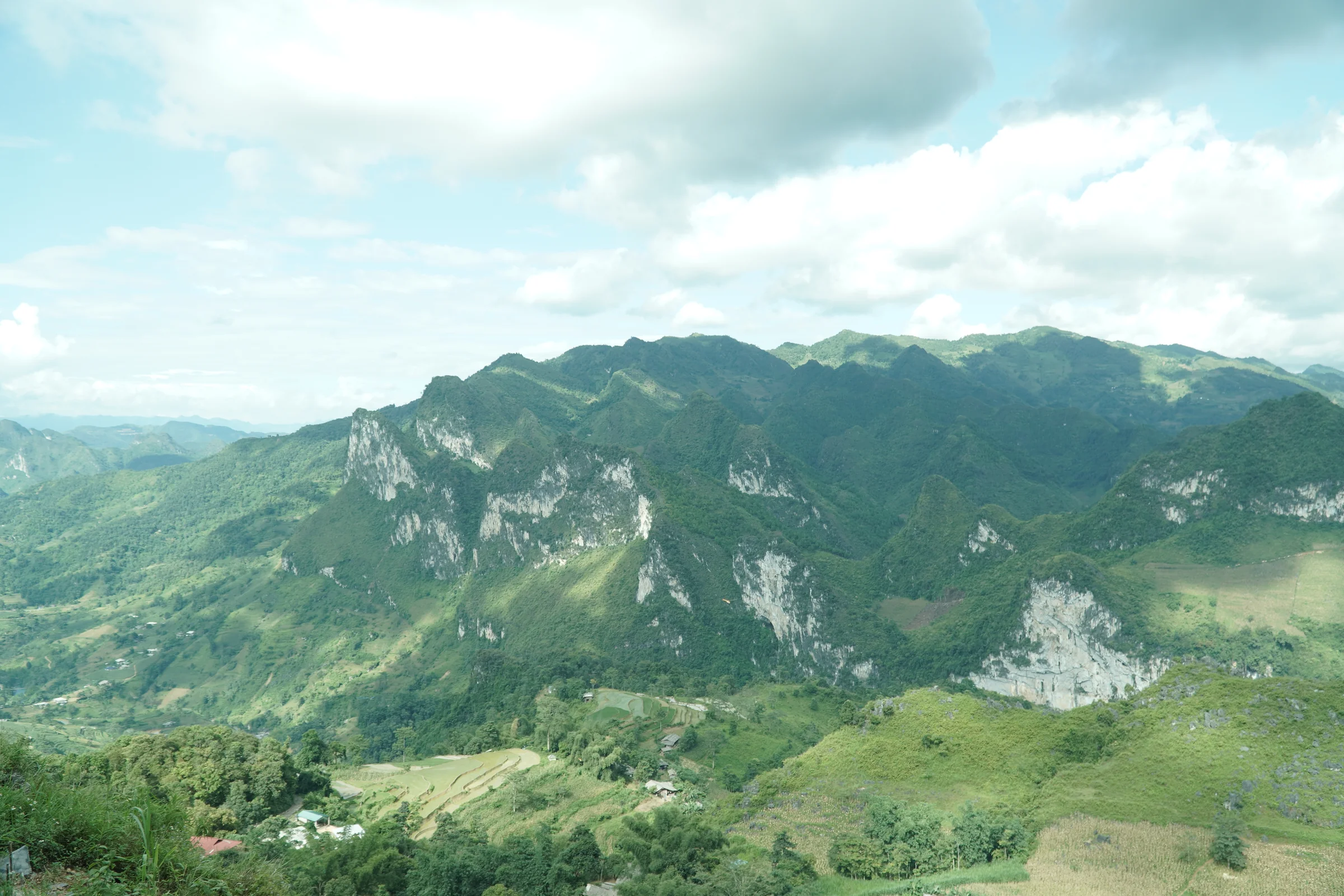
Month by month, and what each one costs you
I am not going to crown a winner, because the honest answer changes by person. Here is the trade in each part of the year.
- January and February: driest and clearest of the year, and February is the single driest month. The cost is cold, and fog that can sit on the high passes for a day at a time.
- March and April: still mostly dry, warming up, and the crowds have not fully arrived. April starts tipping into the hot season near the end of the month. This is a quietly good window that few pages mention.
- May to June: hot, and the rain begins. Green everywhere, water in the terraces. The cost is that the sky closes in and long views start disappearing.
- July and August: the wettest and cloudiest of the year. July averages roughly 188 mm of rain and is overcast or mostly cloudy about seven days in eight. You will still ride, but plan on losing time, and do not expect the photographs you came for.
- September: the wet season ends during this month and the sky begins to clear. A genuine transition month, and it can go either way in a given year.
- October and November: dry, clearing, comfortable. This is the window everyone recommends, and they are not wrong. The cost is that everyone else is here too, and beds and bikes book out earlier than you expect.
- December: the clearest month of the whole year, at about two thirds clear or partly cloudy. The cost is that the cold season has started, and it starts on the passes first.
A note on method: I have published figures for four points in the year, which are the coldest month, the driest month, the hottest month and the wettest month. For the months in between, the source gives seasonal ranges rather than separate monthly numbers, so I describe those months as trade-offs instead of inventing figures for them. Weather here also varies year to year. Treat every line above as a pattern, not a promise.
What actually stops a ride, rain or fog?
If you take one thing from this page, take this.
Rain is a comfort problem, which means you get wet, you go slower, you arrive later, and although it is unpleasant it remains entirely manageable.
Fog is a visibility problem, and visibility is the thing that keeps you alive on a road with blind corners and trucks that use the middle of it. When cloud sits on a pass, you can be down to a few metres of sight. That is not a slow-down situation. That is a wait situation.
Do not ride a pass you cannot see across, in any month. Wait an hour, or reroute lower. Fog burns off or lifts far more often than people expect, and the pass will still be there. Riding blind on Ma Pí Lèng is the single most avoidable risk on this route.
The practical version is to ask at your homestay every morning, because people here know what the passes are doing well before any app does. That said, it is worth checking the official picture too: Vietnam’s National Center for Hydro-Meteorological Forecasting publishes regional forecasts and storm warnings (retrieved 2026-08-02), and the UK Foreign Office travel advice for Vietnam keeps a running note on typhoon season and flooding (retrieved 2026-08-02). Between a local answer and an official warning you have everything a forecast app was going to tell you, and rather more besides.
Does the weather change what you should book?
A little, and less than you would think.
The month affects your comfort far more than it affects the decision of whether to ride yourself. That decision runs on your licence, your riding experience, and your insurance, and it does not change with the season. I have written that out separately in self-drive versus easy rider and in whether you need a licence here.
Two things the season genuinely does change:
Book earlier for October and November. That window is the most popular of the year, and beds and bikes go early. If you want a specific homestay, weeks matter.
Budget a little more for the wet months. Not because prices rise, but because a lost afternoon sometimes turns into an extra night. The full cost breakdown has the day rates.
Ha Giang sits in northern Vietnam, so the province’s pattern rides on top of a national one. The best time to visit Vietnam has a month-by-month grid for all three climate zones, which is the one to read if the Loop is part of a longer trip.
Ha Giang weather: common questions
What is the best month to visit Ha Giang?
There is no single best month, and anyone who gives you one is simplifying. October and November are dry, clear and comfortable, which is why they are crowded. February is the driest month of all but it is cold. March and April are a quiet, mostly dry window that few guides mention. Pick the trade-off you mind least.
When is the rainy season in Ha Giang?
Roughly early May to late September, with July the wettest month at around 188 mm on average. It usually rains in heavy bursts rather than all day, so it costs you hours rather than whole days.
How cold does Ha Giang get?
January is the coldest month, averaging a low near 13°C and a high near 20°C in the town. On the high passes, moving on a bike, it feels considerably colder than that. Bring layers and gloves for any trip between December and February.
Can you ride the Ha Giang Loop in the rain?
Yes, and thousands do every wet season. Wrap your luggage, buy a local poncho, and slow down for the first ten minutes of any shower when the road is most slippery. The thing to wait out is fog, not rain.
Which month has the clearest skies?
December, at roughly two thirds of the time clear or partly cloudy. It is also the start of the cold season, so you trade visibility for temperature.
Is August a bad time to come?
It is the hardest month for weather, sitting in the wettest and cloudiest stretch of the year. It is not a bad time to come if you want green terraces, fewer travellers and lower pressure on beds. It is a bad time to come expecting long views.
Pick your month by what you are willing to give up, then build a spare half day into the route. That single habit does more for a trip here than choosing the perfect week ever will.
Written by Jasmine (Thuy Bui), born and raised in Ha Giang. This site sells nothing and I no longer run tours. I co-founded Jasmine Ha Giang, a licensed local tour operator (Business Registration Certificate #5100503221, issued 11 March 2025), and I still hold a share in it; the team there operates it without me. My work now is free advice for travellers and social projects in the province.
Leave a Reply