Key Takeaways
- Check your licence before you weigh anything else. It decides whether your travel insurance pays out, which matters more than which option sounds better.
- Most bikes rented for the Loop sit either side of the 125 cm³ line, and Vietnam changed that line on 1 January 2025. The bike you are given decides which licence class you need.
- An easy rider transfers the risk to someone far more experienced. It does not remove it. You are on the same bike, on the same road.
- For two confident riders sharing a bike, self-drive is usually cheaper and the better trip. That is true even though it costs us money to say it.
- You can often switch partway through, but only if you ask before you book.
Take the easy rider if you do not hold a licence that is valid for a motorbike in Vietnam. That is not a comment on your riding. It is a comment on your insurance, and it is the part almost nobody puts on the page.
If you do hold a valid licence, then the question opens up properly, and the honest answer depends on whether you have ridden a manual bike on a mountain road before. Everything else, the freedom, the photos, the group, matters less than those two things.
Disclosure, before any recommendation
This site sells you nothing. I also hold a share in a Ha Giang (Hà Giang) tour operator that I co-founded and stepped back from running, so I benefit if you book with them. Read everything below knowing both halves.
Almost every other page making this comparison is published by an operator, and most of them do not tell you. I am not going to name or link that product anywhere in this article. What I will do is tell you the parts that cost it money, starting with the section on price.
What each option actually is
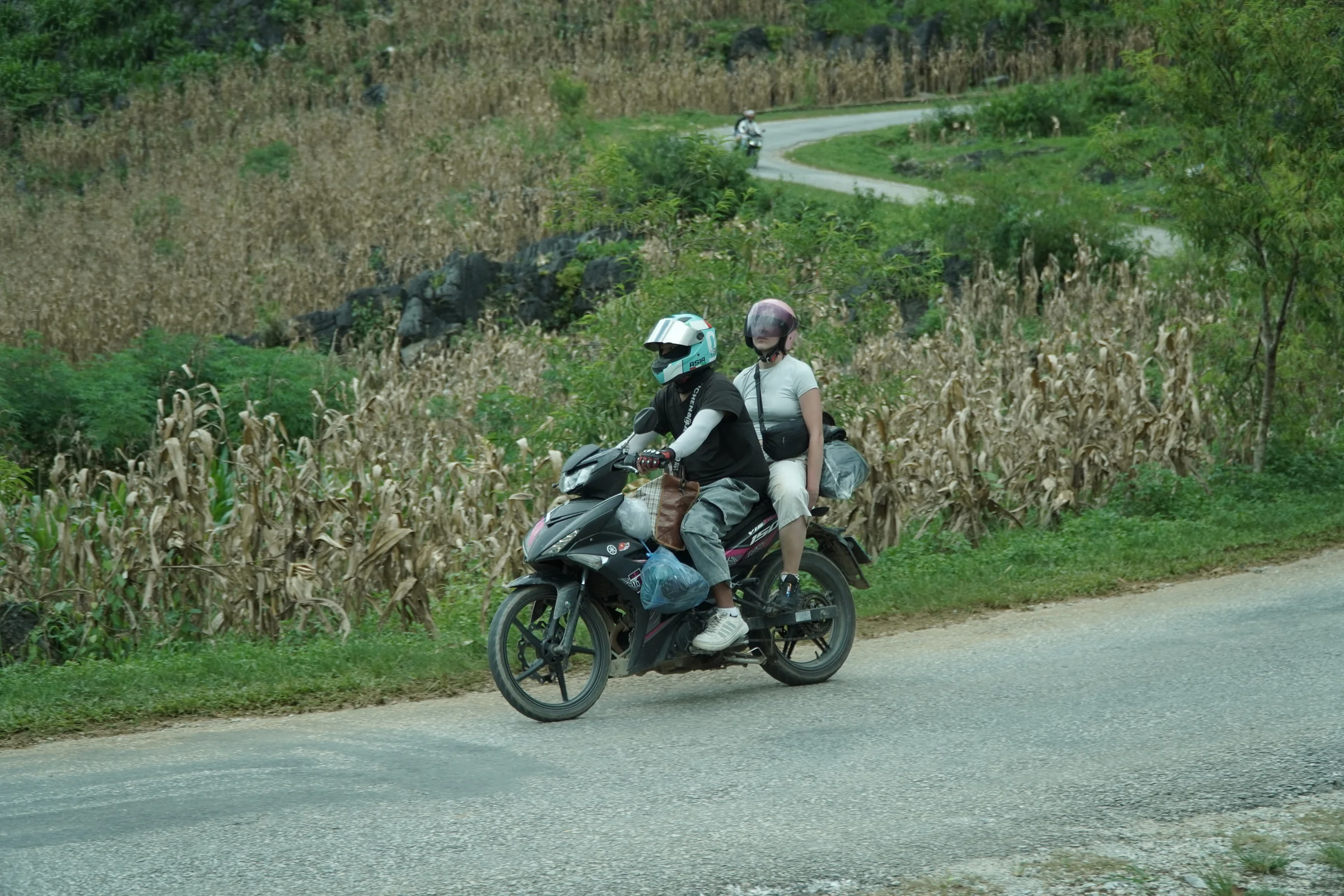
Easy rider. A local driver rides the bike and you sit pillion, which just means the passenger seat behind them. You carry nothing, you steer nothing, and you look wherever you like. Your driver is usually also your guide.
Self-drive. You ride your own bike. On the Loop this almost never means riding alone. Most self-drive bookings put you in a group with a lead guide in front and a tail guide at the back, and your luggage goes in a support vehicle or on the guide’s bike.
That surprises people. “Self-drive” sounds like independence, and mostly it means you are steering inside a convoy that stops where the convoy stops.
The bike you get is usually one of two kinds. A Honda Wave is semi-automatic, which means you change gear with your foot but there is no clutch lever to pull. An XR150L or a Winner X is a manual with a clutch, taller and heavier, and noticeably more bike than a scooter.
Hold that detail. It comes back in the next section.
Does your licence decide this for you?
Often, yes. And the rule changed recently enough that a lot of what you will read is out of date.
From 1 January 2025 Vietnam sets its motorbike licence classes at A1 for bikes up to 125 cm³ and A for anything above 125 cm³. Guides written before 2025 still quote the old boundary of 175 cm³, which no longer applies.
Now put that against the bikes. A Honda Wave at around 110 cm³ falls under A1. An XR150L at 149 cm³ and a Winner X at 150 cm³ do not. They sit in the class above, which is the class most travellers have never heard of and have not got.
So the bike your shop hands you can quietly move you into a different licence class than the one you arrived expecting. Ask which model you are getting, in writing, before you pay.
If you ride without a licence that covers the bike, the penalty depends on that same 125 cm³ line. For a bike at or under 125 cm³ the fine runs from 2,000,000 to 4,000,000 VND. For a bike above 125 cm³ it runs from 6,000,000 to 8,000,000 VND. Riding without the compulsory Vietnamese third-party insurance certificate carries a separate 200,000 to 300,000 VND penalty.
Fine brackets from Nghị định 168/2024/NĐ-CP, Điều 18 khoản 5, khoản 7 and khoản 2(b). Licence classes from Luật Trật tự, an toàn giao thông đường bộ 2024 (Luật số 36/2024/QH15), Điều 57. Both retrieved 2026-08-02.
Foreign riders generally need an International Driving Permit issued under the 1968 convention, carried together with their own national licence. The UK government’s Vietnam travel advice states plainly that British riders need both, and that riding without third-party insurance is illegal in Vietnam.
Permit rules differ by country, so the full version lives on its own page: which convention your country issues under, and what to do if yours issues the wrong one. See the licence rules for the Ha Giang Loop.
What happens to your insurance either way?
This is the part the whole decision turns on, and I could not find it addressed on a single page ranking for this question.
The short version, as I understand it: most travel policies will cover you medically as a pillion passenger without requiring you to hold any permit yourself, because you are not driving. But that cover is usually conditional on the person driving being legally licensed. Ride behind a local driver on a valid Vietnamese licence and you are inside your policy. Ride behind a friend who rented a bike on a permit that does not cover it, and you may not be.
For self-drive the exposure is more direct. If you crash without a licence valid for that bike, insurers can and do refuse the claim, and that refusal can stand even when you hold travel insurance.
Claim-refusal for undocumented riders per the looptrails.com Ha Giang motorbike insurance guide, retrieved 2026-08-02. Pillion-cover conditions compiled from several traveller-insurance explainers, retrieved 2026-08-02. Policy wording varies by insurer and country, so treat this as the shape of the rule, not as your policy.
Read that as a prompt, not a promise. I am not an insurer and I have not read your policy. Policies differ enormously, and some exclude motorbikes above a stated engine size. Only your own product disclosure statement settles it. Search it for “motorcycle”, “pillion” and “licence” before you book either option.
That is the whole of my advice on insurance, and it is free: go and read the document.
Is an easy rider actually safer?
Mostly, yes, and it is worth knowing why rather than taking it on trust.
Your driver has ridden these roads hundreds of times. They know which corners on Ma Pi Leng (Mã Pí Lèng) are blind, where gravel collects after rain, and how the trucks behave on the climb out of Dong Van (Đồng Văn). None of that is available to you on your third day of riding a manual bike.
Here is the part an operator would rather not write. Riding pillion transfers the risk. It does not delete it. You are on the same bike, on the same road, with the same trucks coming the other way, and as a passenger you have no brakes and no steering. You have swapped control for competence. For most first-timers that is a good trade. It is still a trade, not a shield.
You will see accident numbers quoted for this road. Treat them with suspicion. There is no reliable public dataset for foreign riders on the Loop, and most figures floating around are either guesses or national road statistics that describe city traffic. Serious accidents happen here every season, enough that every rental shop has a story. That is as precise as anyone can honestly be.
Which one costs less?
It depends on whether you are one person or two, and that flips the answer completely.
Riding solo, you pay for a whole bike by yourself, plus fuel. Two of you sharing one bike split that same cost. But two of you booking easy riders pay for two drivers, because a driver can only carry one passenger. So the more people in your group, the more the maths tilts toward self-drive.
One cost that never appears in a quote: each of those drivers gets tipped separately at the end, and the figure is larger than most people budget for. Work it out before you compare, not after: how much to tip your Ha Giang Loop easy rider. The Loop is the exception. Tipping is not customary across the rest of Vietnam, so do not carry the Loop habit south with you: tipping norms in Vietnam.
I am not going to give you a day rate. Prices here move, and a number typed once and left on a page for two years is worse than no number. The dated breakdown lives in the full Ha Giang Loop cost guide, which I keep current.
What I will tell you is the conclusion that costs us money. If there are two of you, you both have valid licences, and at least one of you is genuinely comfortable on a manual bike, self-drive is usually the cheaper option and the better trip. Book that. An operator who tells you otherwise without asking how many of you there are is selling, not advising.
What you give up with each
With self-drive you give up the view. This sounds like a small thing and it is not. On the stretch of Ma Pi Leng above the Nho Que (Nho Quế) river, the road demands your eyes. You will remember riding it. You will not remember looking at it, unless you stop, and in a group you stop where the group stops.
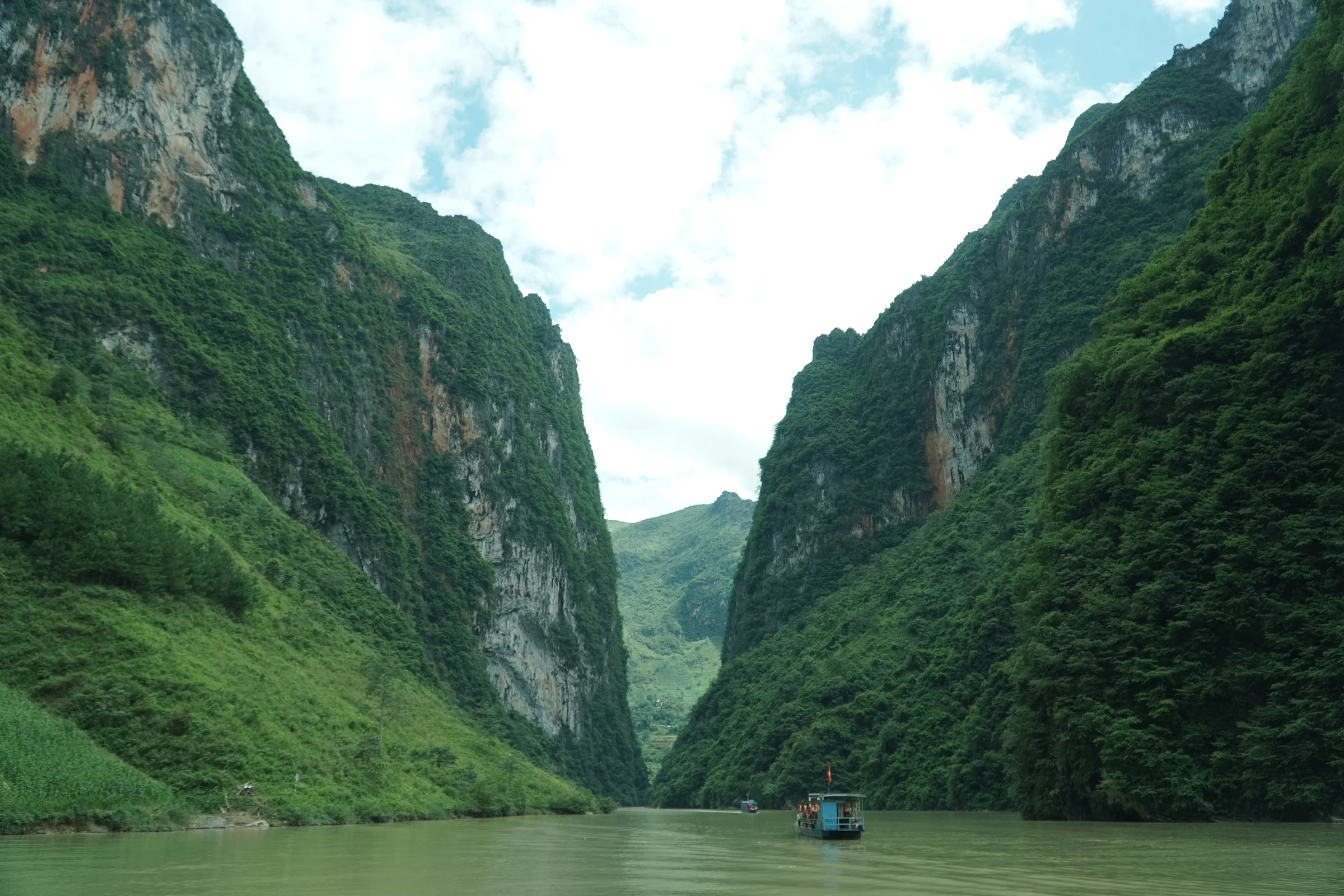
With an easy rider you give up the timing. You go at the group’s pace, you leave when they leave, and if you want twenty more minutes somewhere you negotiate for it.
There is a third option worth one line. Jeep tours suit people who want the road without the bike, and they deserve their own comparison.
Can you change your mind partway through?
Usually, yes. This gets asked constantly and answered almost nowhere.
Most operators running self-drive groups have drivers travelling with the group anyway, so moving you onto the back of a bike on day two is often possible. The pattern I see most is someone doing day one on their own bike, finding the descent harder than expected, and switching for the rest of the trip.
The catch is that you have to ask first. Get it confirmed in a message before you pay, including what it costs to switch, because an operator who has not agreed to it in advance is under no obligation on day two. Ask the reverse too, in case you find your feet and want to take a bike later.
A note on method: the legal figures here come from the Vietnamese decree and road-safety law, not from tour operators, because operator pages in this niche contradict each other on the licence question. The insurance section is compiled from secondary explainers and is flagged as needing policy-level verification. No price appears in this article, because I do not have a first-party rate I have checked recently enough to publish.
So which one is for you?
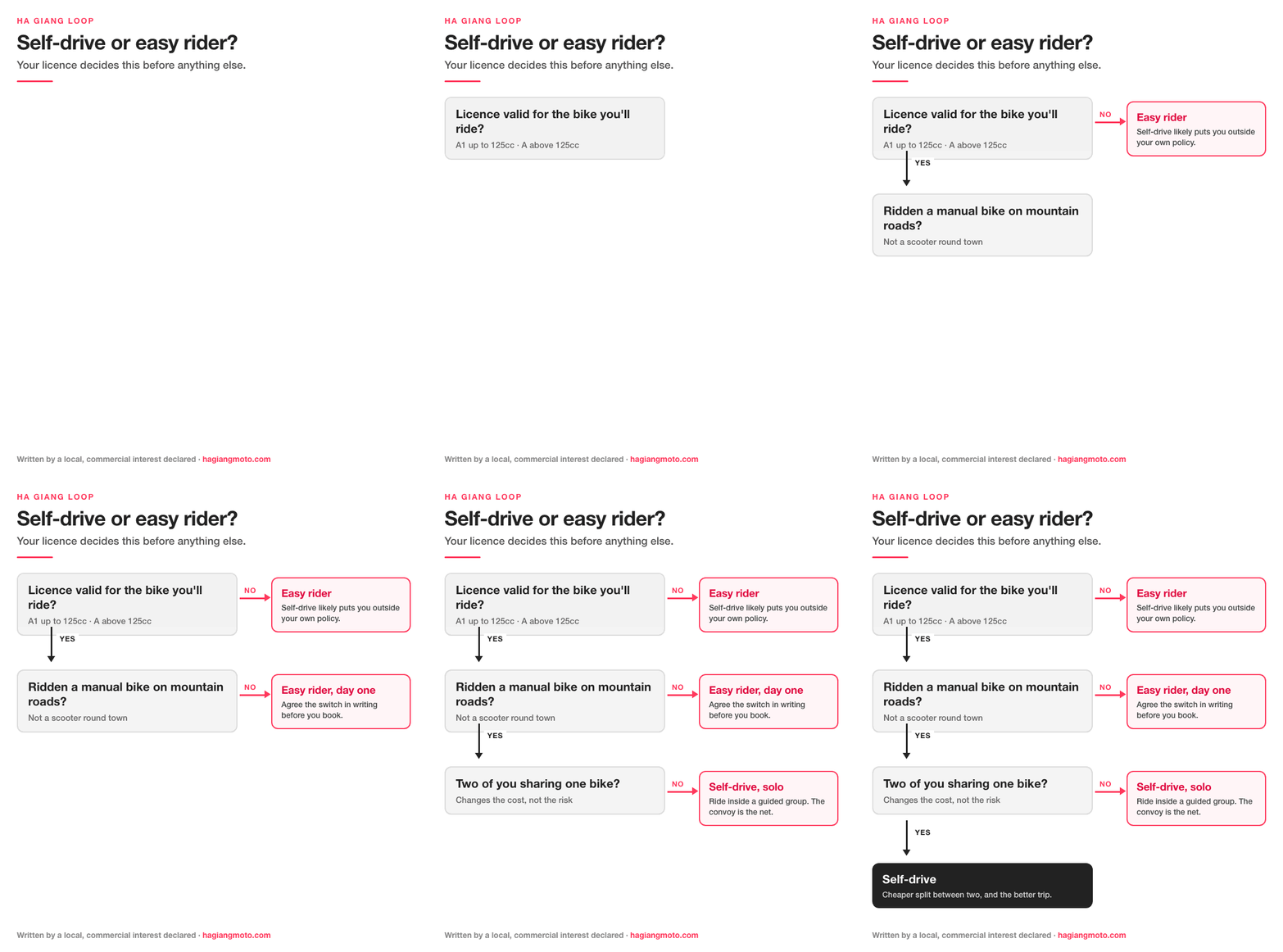
| Your situation | Take | Why |
|---|---|---|
| No licence valid for a motorbike in Vietnam | Easy rider | Not a confidence question. Self-drive likely puts you outside your insurance. |
| Valid licence, never ridden a manual bike | Easy rider, at least for day one | Learn the road as a passenger, then ask to switch if you want it. |
| Valid licence, ridden manuals but not mountains | Self-drive, with a guided group | The convoy is the safety net. Ride your own pace inside it. |
| Valid licence, confident rider, two of you | Self-drive | Cheaper split between two, and the better trip. |
| Want the photos and the conversation more than the ride | Easy rider | You cannot look at Ma Pi Leng and ride it at the same time. |
| Travelling alone on a tight budget, no licence | Easy rider | The fine for the wrong licence class on a 150 cm³ bike costs more than the difference. |
If you are still unsure after that table, you are probably in the second row, and the answer is to take the easy rider for day one with the switch agreed in advance. That is the most reversible version of this decision, and reversible is worth a lot on a road you have not seen yet.
Your next step is the licence, because it gates everything above. Start with which permit your country issues and whether it works here, then come back and pick a row.
If you land on the guided side of this decision, the next question is who to book it with. Choosing a Ha Giang Loop tour operator works through the five questions to ask before you pay, and an arithmetic test for prices that look too good.
Frequently asked questions
Do I need a licence to ride the Ha Giang Loop myself?
Yes. You need a licence valid for the class of bike you are riding, which since 1 January 2025 means A1 for bikes up to 125 cm³ and A above that. Foreign riders generally need a 1968 International Driving Permit carried alongside their national licence. Riding without one carries a fine of 2,000,000 to 4,000,000 VND on a smaller bike and 6,000,000 to 8,000,000 VND on a bike above 125 cm³.
Does my travel insurance cover me if I ride as a passenger?
Usually you do not need a permit of your own to be covered as a pillion passenger, but most policies require the person driving to be legally licensed. A local easy-rider driver on a Vietnamese licence meets that. A friend riding on the wrong permit may not. Check your own policy wording rather than relying on any blog, including this one.
Is self-drive cheaper than an easy rider?
For two people sharing one bike, usually yes. For one person travelling alone the gap narrows, because a solo rider pays for a whole bike. Ask for a quote both ways with your actual group size before you decide.
What kind of bike will I get on a self-drive tour?
Usually either a semi-automatic Honda Wave of around 110 cm³, where you change gear with your foot and there is no clutch lever, or a manual XR150L or Winner X at about 150 cm³. The difference matters, because the two sit on opposite sides of Vietnam’s 125 cm³ licence boundary. Ask which model you are getting before you pay.
Can I switch from self-drive to an easy rider during the trip?
Often yes, because drivers usually travel with the group anyway. Agree it in a message before you book, including the cost, because an operator who has not agreed in advance does not have to accommodate you on day two.
Leave a Reply