Key Takeaways
- Budget roughly $120 to $350 per person for three days, all in. Day rates run about $20–35 budget, $45–80 mid-range, $120+ comfortable.
- Published prices disagree by about 2x because every site draws a different line around what “the cost” covers. Nobody states their line.
- The most expensive mistake is not a price. It is arriving with the wrong type of International Driving Permit, which can void your insurance entirely.
- The riskiest money is the deposit, and some shops ask for your passport instead of cash. Do not agree to that.
- Almost every page ranking for this question is written by a company selling the trip it is pricing. That includes this one, indirectly. It is disclosed below, and it is why this page also tells you when not to book a tour.
- Prices below were checked on 2 August 2026. Vietnamese travel prices move. Treat any undated price table, including this one a year from now, as a rough guide.
Introduction
Search “Ha Giang Loop cost” and you will get five confident answers that contradict each other. One site says a three-day self-drive trip costs $101. Another says $135. A third says $90 to $120. They cannot all be right, and none of them explain the gap.
There is a reason for that. I checked the top results one by one, and nearly every single page is published by a company that sells Ha Giang Loop tours. Their cost guide is their sales page, and not one of them says so. I am going to say so, because I am connected to one too.
Disclosure, before any numbers
This site sells you nothing. No tours, no bookings, no affiliate links. And I still own a share of Jasmine Tours, a Ha Giang (Hà Giang) operator that sells this exact trip. I co-founded it and stepped back from running it, so the team there works without me, but I benefit if you book with them.
I say the second part because of the first. A page with nothing to sell reads as neutral, and that is exactly when a stake you cannot see bends what you believe. So here is how to check whether it bent these numbers. This article tells you when self-drive beats hiring a guide, what a rental shop’s deposit and damage charge can do to your budget, the licence rule that voids most travellers’ insurance, and how to read any operator’s price, including the one I hold a share in. If I were writing this to sell you a tour, those four sections would not be in it.

Here is what the trip actually costs, why the internet’s numbers disagree, and where the money goes wrong.
So what does the Ha Giang Loop actually cost?
For three days, most travellers spend between $120 and $350 per person. That range covers the ride itself, a bed each night, food, petrol, and the bus from Hanoi (Hà Nội) and back.
It does not cover travel insurance, souvenirs, a damage charge if something goes wrong, or the flight to Vietnam. Those exclusions are where most “cheap” numbers hide.
I am Jasmine. I was born in Ha Giang, and my work is advising travellers who come to Vietnam. I am not going to quote you one clean figure, because there isn’t one. What there is, is a clear structure underneath the noise.
| Way of riding | Typical 3-day published price | Who it suits |
|---|---|---|
| Self-drive | ~$100 to $135 | Confident riders on a budget |
| Easy rider (you ride pillion) | ~$155 to $190 | Most first-timers |
| Jeep | ~$229 to $315 | Families, couples, anyone not on two wheels |
Figures compiled from published 2026 rates at hagiangtrips.com (published June 2026) and looptrails.com, both retrieved 2026-08-02.
Why does every website give you a different number?
Because each one silently draws a different boundary, and none of them tell you where.
Look at what four sources say about the same thing, a three-day self-drive trip:
| Source | Their number |
|---|---|
| hagiangtrips.com (June 2026) | 2,600,000 VND, about $101, described as all-inclusive |
| looptrails.com | 3,390,000 VND, about $135 |
| Aggregated blog figures | $90 to $120, stated as excluding insurance and transport |
| A traveller’s own 4-day log at vietadvisor.travel | 3,500,000 to 4,500,000 VND, about $140 to $180 |
That is a spread of roughly two to one. None of these sites is lying. They are answering different questions and calling them the same thing.
So before you trust any Ha Giang Loop price, including mine, ask it four questions:
- Does it include the bus from Hanoi and back? That alone is 500,000 to 1,100,000 VND, per published 2026 rates, retrieved 2026-08-02. It moves a budget by a third.
- Does it include petrol? Around 250,000 to 350,000 VND for the full loop. The circuit is roughly 300km and burns 8 to 10 litres.
- Does it include food, or just the meals inside a tour package?
- Is it a dorm bed or a private room? A dorm runs 100,000 to 150,000 VND a night. A private homestay room runs 300,000 to 400,000 VND.
Answer those four and any price on the internet becomes readable. Skip them and you are comparing numbers that were never comparable.
What does each way of riding cost, layer by layer?
Price it in layers, not as one lump.
Self-drive. The bike is the cheap part. A semi-automatic from a Ha Giang hostel is quoted at 150,000 to 250,000 VND a day, and a Honda XR at around 300,000 VND a day (published 2026 rates, retrieved 2026-08-02). Add petrol, your own beds, and your own food.
Easy rider. You ride on the back and a local driver rides. Published three-day rates run about $155 to $190 and usually fold in accommodation, meals, and the guide. Priced on its own, a driver runs roughly 500,000 to 800,000 VND a day.
Jeep. Published three-day rates run about $229 to $315 per person, dropping as the group grows. This is the option for anyone who should not be on two wheels, and there is no shame in it.
Here is the part a rental shop has no reason to tell you: self-drive is not automatically the cheaper option. It is cheaper on paper. Once you add a deposit you may not get back in full, a damage charge you cannot dispute in a language you do not speak, and the cost of a day lost to a breakdown, the gap narrows.
For a confident rider it is still the better deal and the better trip. For someone who has never ridden a manual bike, the easy rider price is often the honest one.
Cost is only half of that decision. The other half is your licence, because it decides whether your insurance pays: self-drive vs easy rider on the Ha Giang Loop.
What does a single day on the Loop cost?
This is the table most guides skip, and it is the one that actually helps you plan. Every figure is per person, per day.
| Line | Budget | Mid-range | Comfortable |
|---|---|---|---|
| Bed | $4 to $8 (dorm) | $12 to $25 (homestay room) | $40+ |
| Food | $3 to $6 | $8 to $15 | $25+ |
| Bike rental | $6 to $10 | $10 to $15 | $20+ |
| Petrol | $3 to $5 | $3 to $5 | $3 to $5 |
| Driver (easy rider) | $0 (you ride) | $20 to $32 | $50+ |
| Day total | $20 to $35 | $45 to $80 | $120+ |
Per-day ranges compiled from roammate.com, retrieved 2026-08-02.
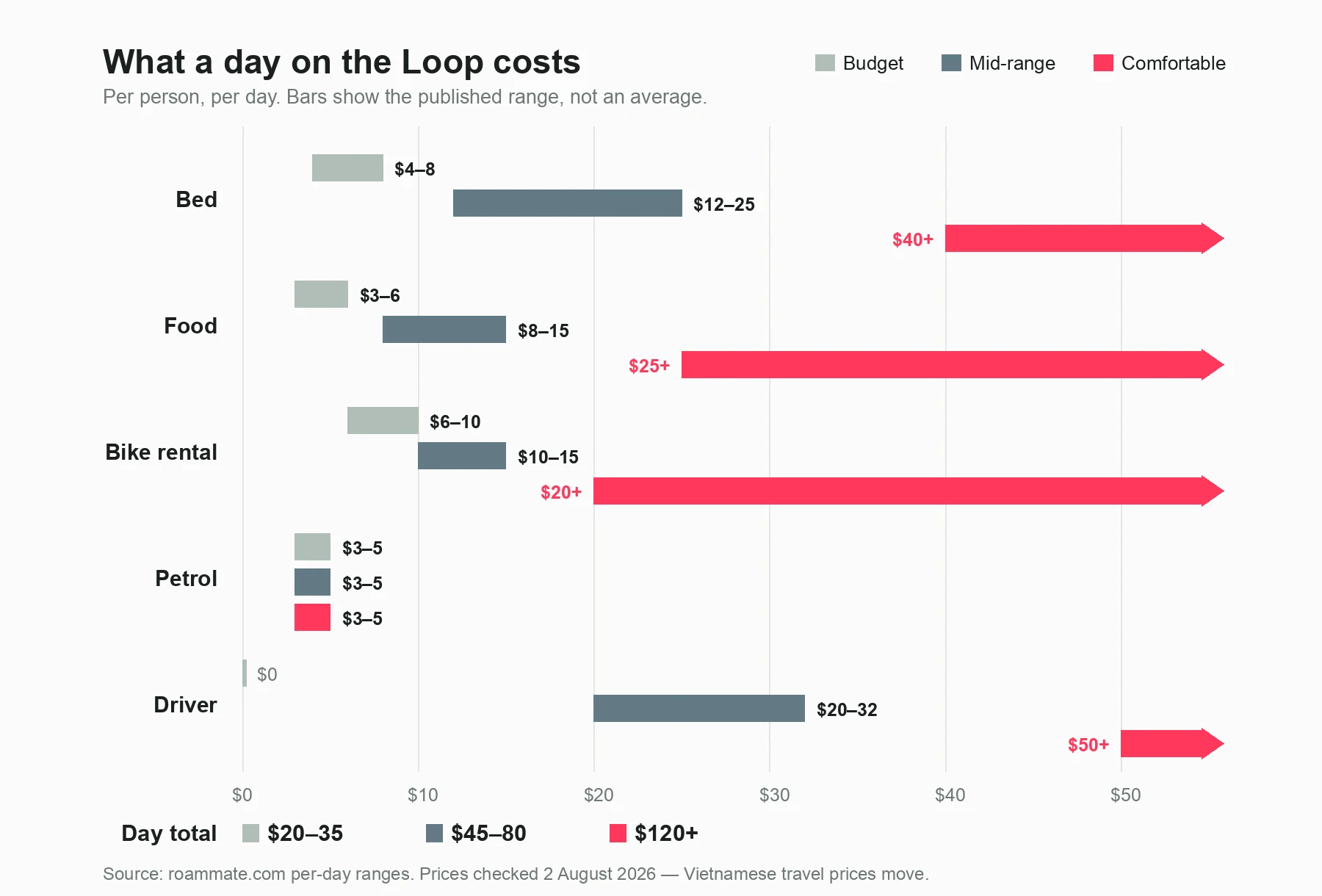
Two things to notice. First, the bed and the driver are the only lines that really move; petrol barely changes whatever you do. Second, the jump from budget to mid-range is mostly one decision, a private room instead of a dorm bed. If you want to spend less, that is the lever, not skipping meals.
Local food is cheap and good. A bowl of pho (phở) or bún runs 25,000 to 35,000 VND, about $1 to $1.40. Com binh dan (cơm bình dân), the rice-and-dishes plate that every small town serves, runs 30,000 to 40,000 VND.
If you are staying in homestays, dinner and breakfast are usually included in the room price, which is why the homestay line looks expensive next to a dorm and often isn’t.

The licence rule that costs more than the whole trip
This is the section I most want you to read, and it is the one almost no cost guide covers properly.
Vietnam recognises only International Driving Permits issued under the 1968 Vienna Convention on Road Traffic. That is not a technicality. IDPs issued under the older 1949 Geneva Convention are not recognised, and a rider carrying one is treated as riding without a licence.
Here is why that matters to you specifically: the United States, Canada, Australia, New Zealand, Japan and Singapore all issue 1949 IDPs.
If you are from one of those countries and you walked into an automobile association, paid your fee and received an IDP, there is a good chance the document in your bag is not valid here.
The governing regulation is Circular 12/2025/TT-BCA, issued by Vietnam’s Ministry of Public Security, which sets out that IDPs are recognised for nationals of countries party to the 1968 Convention, as reported by Vietnam Law Magazine. The motorbike categories themselves changed on 1 January 2025: hạng A1 now stops at 125cc and hạng A covers everything above it, where the old scheme let A1 run to under 175cc. Most bikes rented for the Loop are above 125cc, so an A1 entitlement no longer covers them. The full rule, with the clause numbers, is in our guide to whether you need a licence for the Ha Giang Loop.
Legal position and the Circular reference retrieved 2026-08-02. This is a legal question with real consequences, so verify your own country’s IDP convention with your issuing authority before you travel rather than relying on any travel blog, including this one.
The fine is the small part, and it is worth getting from the law rather than from an operator. Under Nghị định 168/2024/NĐ-CP, Điều 18, in force since 1 January 2025, riding without a valid licence costs 2,000,000 to 4,000,000 VND, about $75 to $150, on a bike up to 125cc, and 6,000,000 to 8,000,000 VND, about $230 to $305, on a bike above 125cc.
Both checked August 2026. Most bikes rented for the Loop are above 125cc, so the second bracket is the one that applies to you.
The expensive part is insurance. Insurers can and do deny claims for a rider who was not legally licensed, which turns a hospital bill, a medical evacuation, or a claim against a third party into money you pay yourself.
That is the line item that can exceed the entire cost of the trip, and it never appears in a price table.
I am not going to reassure you that enforcement is casual, because that reassurance is exactly what leaves people uninsured in a hospital in Ha Giang. There are police checkpoints on this route. Check your own policy wording and your own country’s IDP convention before you decide how you are going to ride.
What’s the money nobody puts in the table?
This is the section the tour operators leave out, and it is the one that costs people real money.
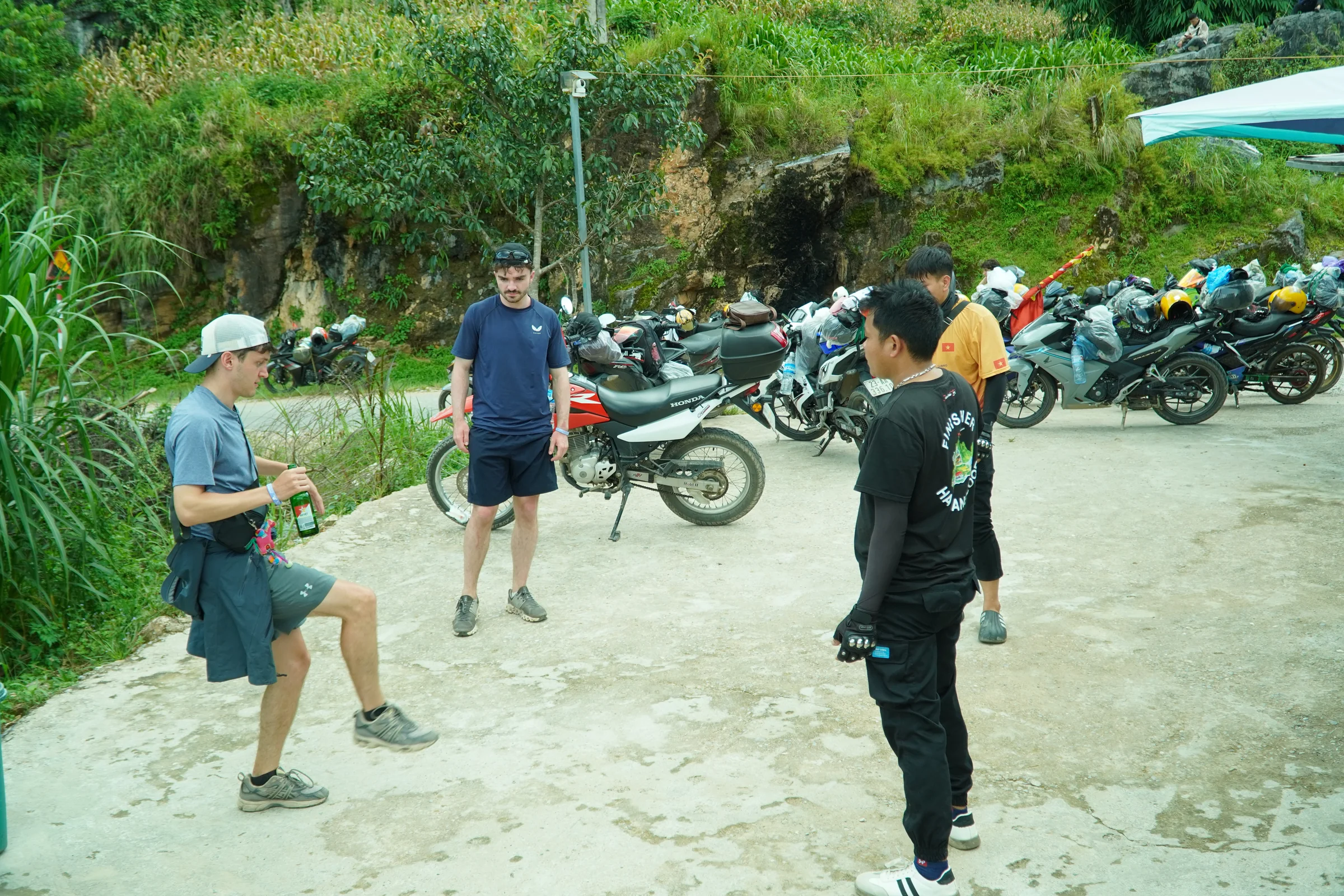
The deposit, and the passport problem. Rental shops hold a deposit. Published figures run from roughly 90,000 to 450,000 VND at the low end up to $50 to $100 at others.
Some shops will offer to hold your passport instead. Do not agree to that. A passport is not collateral, recovering one from a shop in a dispute is far harder than recovering cash, and you need it to check into accommodation. Pay the cash deposit or use a different shop.
The damage charge. This is the genuine risk. Travellers regularly report being charged for scratches and dents that were on the bike before they touched it.
The defence is simple and it costs nothing: before you ride away, test the brakes, the lights and the horn, then photograph and video every existing scratch with the shop’s own signage in the frame. Do it slowly and let them watch you do it. A shop that objects to being filmed is telling you something.
“Damage insurance”. Some shops sell an add-on at 100,000 to 200,000 VND a day. Read what it excludes. Reported exclusions include major damage, theft, and any accident involving injury, which are precisely the events you would want covered.
Breakdowns. Roadside repairs are cheap and common. A puncture or a chain adjustment at a village shop costs very little. What costs you is time: a lost half-day on a three-day itinerary means skipping something, and if you are on a tight bus connection back to Hanoi it can mean a night you did not budget for.
Build one buffer afternoon into a three-day plan, or take four days.
Cash. ATMs thin out fast once you leave Ha Giang town. Most homestays, village kitchens and small shops are cash only. Draw what you need before you set off and carry more than you think.
Tips. If you take an easy rider, a tip is expected and it is not in the package price. Budget 500,000 to 1,000,000 VND per rider for a three-day trip, which is roughly one to two extra days of what your driver earns. Ha Giang operators publish figures from 200,000 to 1,000,000 for the same trip, so the range is worth understanding before you pick a number: how much to tip your Ha Giang Loop easy rider. The rest of the country works the other way round, and tipping is not customary there at all: tipping elsewhere in Vietnam.
Does the season change what you pay?
Yes, and not in the way most people expect. The headline rates move less than the experience does.
September to November is the window most people want: mature rice terraces, then buckwheat flowers, and daytime temperatures around 15 to 25°C. The rice is at its best from September into October, and the buckwheat blooms from late October through November.
That is also when beds are hardest to get, so book the homestay early rather than expecting to pay less by turning up.
The trade-off nobody prices is fog. Visibility on the high sections can close in, and the practical response is to start later in the morning once it lifts rather than to ride into it on schedule. A lost morning is not a money cost, but if it pushes you into a fourth day it becomes one.
Outside that window you will find more room and a quieter road. You will also find more rain, and rain here is not a comfort problem, it is a grip problem.
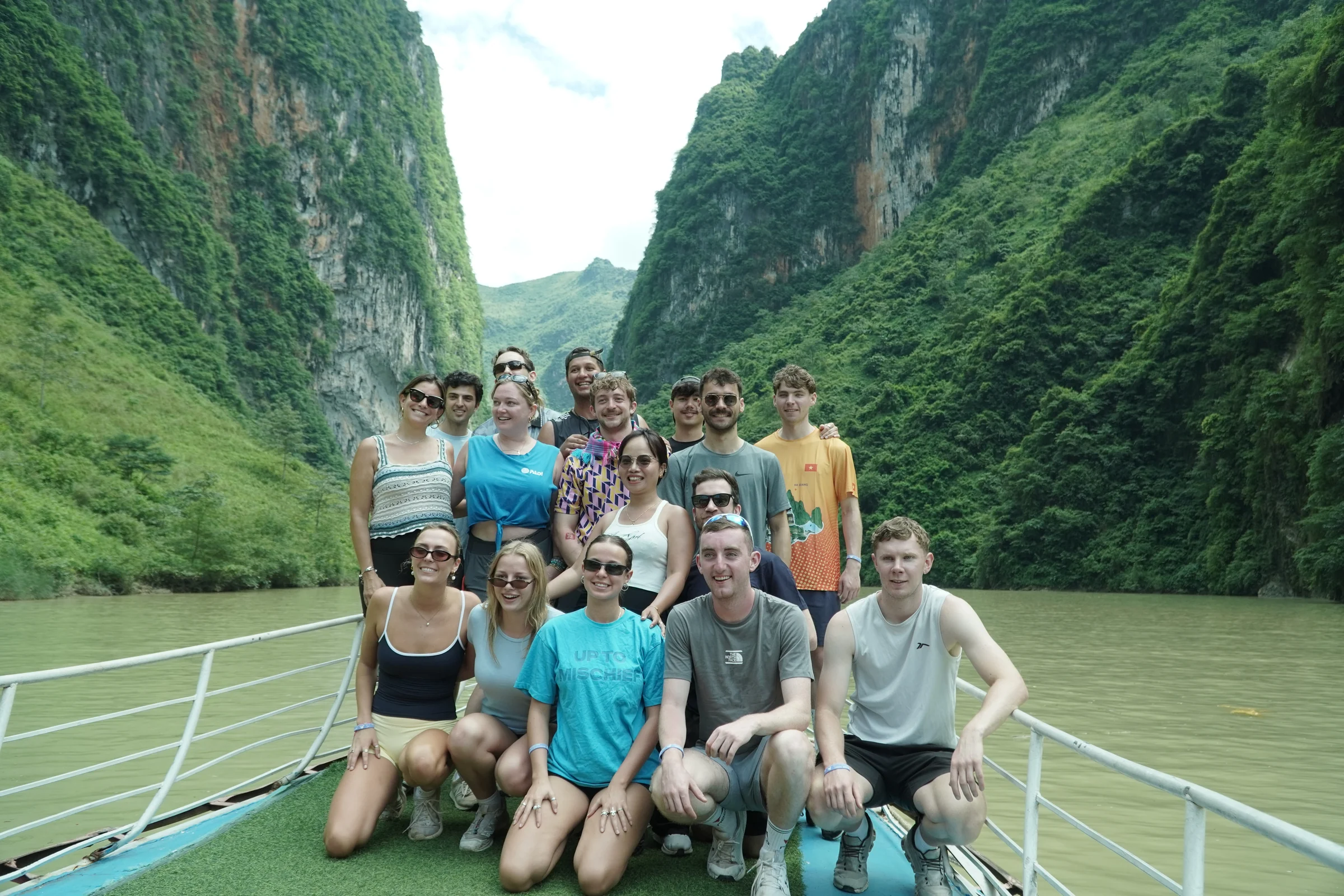
Seasonal pattern compiled from published month-by-month guides at looptrails.com and madmonkeyhostels.com, retrieved 2026-08-02.
Three real budgets: what would you actually spend?
Each of these states its own boundary, which is the thing the rest of the internet skips.
Backpacker, about $120 to $190. Self-drive, dorm beds, street food, sleeper bus both ways. Boundary: includes the Hanoi bus, petrol, food and beds. Excludes insurance and any damage charge.
Middle, about $200 to $280. Easy rider, homestay rooms, meals included in the package, sleeper bus. Boundary: same as above.
Comfortable, about $300 to $450. Jeep or a private room upgrade, better beds, a limousine bus. Boundary: same as above.
For a real, non-package figure: a traveller publishing their own spend at vietadvisor.travel logged 3,500,000 to 4,500,000 VND, about $140 to $180, for four independent days. That is one person’s trip, not an average, but it is one of the few first-person numbers on the internet that is not attached to something for sale.
Is it worth the money?
For most people, yes, and the reason is boring: the cost per day is low and the thing you get is not available anywhere else.
But the honest answer changes by person.
- If you are pricing this on a tight budget, self-drive is real value, provided you can genuinely ride and you photograph the bike before you leave.
- If you have never ridden a manual bike, pay for the easy rider and stop treating the difference as a loss.
- If you are from the US, Canada, Australia, New Zealand or Japan, sort the IDP question before you sort anything else. It is the only line here that can cost you more than the entire trip.

A note on method: every price on this page was taken from its published source on 2 August 2026 and is linked so you can check it yourself. Where sources disagree, I have shown the disagreement rather than averaging it into a single number.
My connection to a tour company is at the top of this article rather than buried at the bottom, which is where you should expect to find it on every page you read about this trip.
FAQ
How much does the Ha Giang Loop cost in total?
Budget $120 to $350 per person for three days, covering the ride, beds, food, petrol and the bus from Hanoi. Insurance, souvenirs and any damage charge sit outside that. Where you land depends mostly on whether you self-drive or pay for an easy rider.
How much per day should I budget?
About $20 to $35 a day riding yourself and sleeping in dorms, $45 to $80 with a homestay room and an easy rider, and $120 or more for a jeep and private rooms. Petrol is only $3 to $5 of that whichever way you travel.
Is self-drive actually cheaper than an easy rider?
On paper, yes, by roughly $50 to $80 on a three-day trip at published 2026 rates. In practice the gap narrows once you count the deposit, a possible damage charge, and the risk of losing a day. It is cheaper for a confident rider and a false economy for a nervous one.
Do I need an International Driving Permit, and which type?
Vietnam recognises IDPs issued under the 1968 Vienna Convention only. IDPs issued under the 1949 Geneva Convention, which is what the US, Canada, Australia, New Zealand and Japan issue, are not recognised. Check which one yours is before you travel, because insurers can deny a claim for an unlicensed rider.
Should I leave my passport as a rental deposit?
No. Some shops will ask. Pay a cash deposit instead or use a different shop. Recovering a passport from a disputed rental is far harder than recovering cash, and you need it to check into accommodation along the route.
How much is motorbike rental per day?
Published 2026 rates run 150,000 to 250,000 VND a day for a semi-automatic and around 300,000 VND for a Honda XR, retrieved 2026-08-02. Ask what deposit the shop holds and what their damage policy says before you agree.
How much petrol does the loop take?
Roughly 250,000 to 350,000 VND for the full circuit, which is around 300km and burns 8 to 10 litres. It is one of the smallest lines in the budget and one of the easiest to forget.
When is the most expensive time to ride?
September to November is the busiest window, with the rice harvest and then buckwheat season. Rates move less than availability does, so the real cost of going in peak season is that you must book beds earlier, not that they cost dramatically more.
The decision
Do not start with a total. Start with two questions: are you riding this yourself, and is the licence in your bag the kind Vietnam recognises? Those two answers move your budget and your risk more than every other line combined.
Once you have answered them, price the layers separately. Bike or seat, beds, food, petrol, the bus from Hanoi. Then add the lines nobody advertises: a deposit you might not see again in full, a buffer for a lost half-day, and enough cash to get you through a route where the ATMs run out.
If a price you find online does not tell you which of those it includes, it is not a price. It is a headline.
Leave a Reply