Key Takeaways
- The deciding factor is not how the bike climbs. It is how it slows down. Engine braking is what keeps your brakes alive on long descents.
- A fully automatic scooter has the weakest engine braking of the three. That is the one real argument against it here.
- A semi-automatic is the sensible default for most visitors: engine braking on the descents, no clutch lever to learn.
- A manual is the best tool for the road if you already ride one. It is a bad place to learn one.
- The transmission also decides your licence class, because the popular manual bikes are all over 125cc.
Disclosure, before anything else
This site sells you nothing. No rental, no bookings, no affiliate links. I do still own a share of a Ha Giang tour company I no longer run, so I benefit if you book with them. Nothing on this page steers you towards a bike anyone makes more money on. In fact the bike I recommend for most readers is not the expensive one.
Almost every discussion of this question is about power. Can the bike get up the hills? That is the wrong end of the problem.
Getting up is easy. Any of these machines will climb Ha Giang’s passes with one rider. What separates them is what happens on the way back down, and that is where the argument actually lives.
Why do descents matter more than climbs?
When you ride down a long mountain descent, you have two ways to control speed. You can use the brakes, or you can let the engine hold you back by staying in a low gear.
If you use only the brakes for twenty minutes of continuous descent, they get hot. Hot brakes fade, which means the same lever pull gives you less stopping. That is the failure mode people do not see coming, because the brakes work perfectly right up until they do not.
Engine braking is the thing that prevents it. Stay in a low gear and the engine does most of the slowing, so the brakes stay cool and stay available for when you actually need them.
That single mechanism is why the transmission question matters here more than it would on a flat coastal road.
The three options, honestly
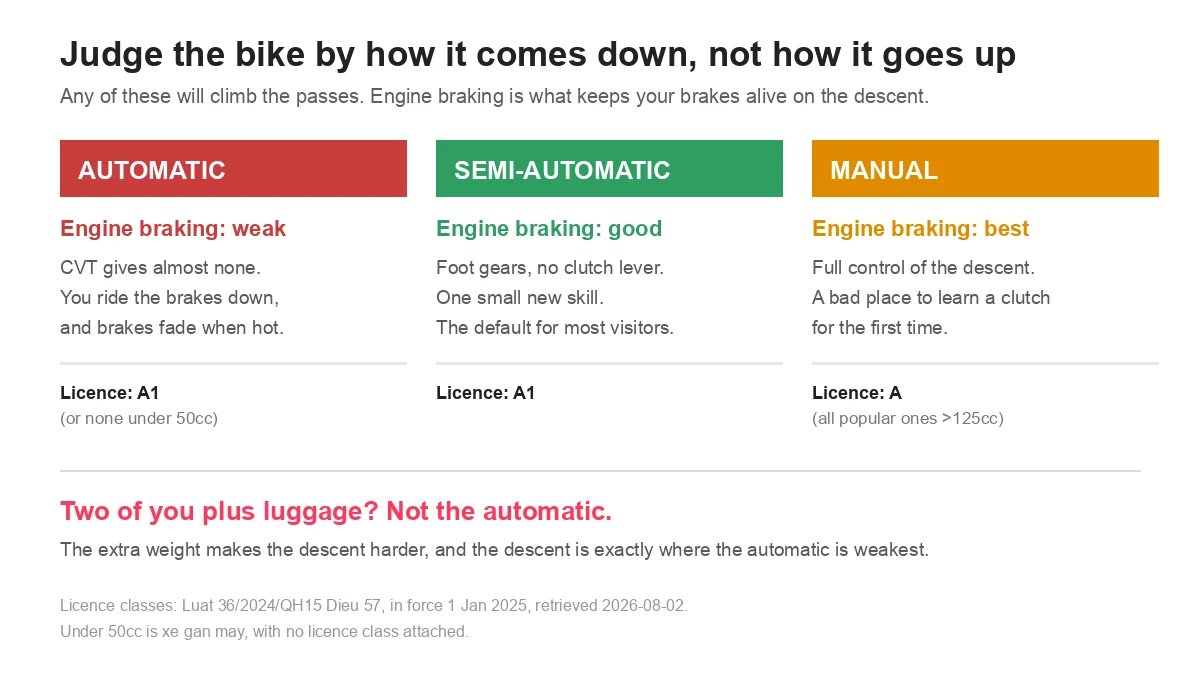
Fully automatic (scooter). Twist and go, no gears at all. Easiest to ride, and by far the easiest if you have never ridden. The problem is that a CVT automatic gives you very little engine braking, so on the long descents you end up riding the brakes. That is the one real strike against it on this road.
Semi-automatic. You change gear with your foot, but there is no clutch lever, so there is nothing to coordinate with your left hand. You get proper engine braking. This is the machine most Vietnamese people ride, and for most visitors it is the right answer.
Manual. Clutch lever, foot gears, full control. The best tool for this road if you already ride one, because you can pick exactly the gear you want for a descent. Also the machine most likely to catch out somebody learning, because you are coordinating two hands and a foot while the road is doing something new.
So which should you rent?
- Never ridden a motorbike: none of them, yet. That question is answered separately in can you ride this with no experience, and the honest answer there is not the one most pages give.
- Ridden automatic scooters only: semi-automatic. It is one small new skill, and it buys you the descent control that the scooter does not have.
- Nervous but experienced on scooters: automatic is acceptable if you commit to riding the descents slowly and using both brakes gently and early. Be honest with yourself about whether you will.
- You ride a manual at home: manual. You already have the skill this road rewards.
- Two of you on one bike with luggage: not the automatic. The extra weight makes the descent problem worse, and that is exactly where the automatic is weakest.
Whatever you take, use both brakes together rather than the front alone, and start slowing well before the corner rather than in it. On a loose or wet surface the front brake alone is what puts people down.
What if your brakes start to fade?

Worth knowing before it happens, because the first time is confusing rather than obviously dangerous.
Fading brakes do not fail suddenly. The lever starts travelling further before anything happens, and the bike slows less than you expected for the same pull. That mismatch is the warning, and the instinct is to squeeze harder, which makes it worse.
What to do instead is simple and slightly counterintuitive.
- Change down a gear and let the engine take the load, if you are on a semi-automatic or manual. This is the whole reason engine braking matters.
- Stop somewhere safe and wait. Ten minutes off the bike is usually enough for brakes to cool. There is no way to hurry it.
- Do not pour water on hot brakes. The temperature shock can warp a disc, and then you have a permanent problem instead of a temporary one.
- Ride the rest of the descent slower. Once brakes have overheated once, they will do it again sooner.
On a fully automatic scooter you have only the first option removed, which is precisely why the descent argument matters. That is also the mechanism sitting behind several of the four causes in the safety guide.
The transmission decides your licence class too
This is the part that connects to paperwork, and it catches people out because it looks like a mechanical question and is actually a legal one.
Vietnam’s licence classes are set by engine size, not by transmission. Under Luật số 36/2024/QH15, Điều 57, in force 1 January 2025 and retrieved 2026-08-02, class A1 covers up to 125 cm³ and class A covers anything above it.
Now look at what that means in practice.
| Transmission | Typical rental bikes | Engine | Licence |
|---|---|---|---|
| Automatic | Airblade 125cc, automatic 50cc | at or under 125cc | A1, or none under 50cc |
| Semi-automatic | Wave 110cc, Future 125cc, PG1 125cc | at or under 125cc | A1 |
| Manual | Winner 150cc, Winner R 150cc, XR 150cc | over 125cc | A |
Every popular manual on the rental lists here is over 125cc. So choosing a manual is not only choosing a harder machine, it is also choosing the higher licence class, and the higher penalty bracket if you do not hold it. Those brackets are in Nghị định 168/2024/NĐ-CP, Điều 18, retrieved 2026-08-02, and the fuller picture is in whether you need a licence here. The one exception at the bottom of the range is a machine under 50 cm³, which Vietnamese law classes as xe gắn máy with no licence class attached: see Thư viện Pháp luật, retrieved 2026-08-07.
Nobody at the rental counter is going to draw that line for you. The price list is a price list.
What does each type cost to rent?
Transmission and price do not track each other neatly, which surprises people.
On a real Ha Giang list checked August 2026, the cheapest bike all in was a semi-automatic Wave Blade 110cc at 280,000 VND a day, and the dearest was a manual XR 150cc at 800,000 VND. But a fully automatic Airblade 125cc sat at 500,000, more than a manual Winner 150 at 420,000.
So you cannot assume the automatic is the budget choice. The full table, including the insurance line that most quotes leave out, is in the rental price breakdown.
A note on method: the mechanical explanation here is standard riding practice rather than anything specific to me, and I am not a mechanic or an instructor. What is specific to here is which machines actually appear on Ha Giang rental lists, and how that maps onto Vietnamese licence classes. The legal points cite the law rather than any rental shop, including the one I hold a share in.
Common questions
Can you ride the Ha Giang Loop on an automatic scooter?
Yes, and many people do. The drawback is engine braking: a CVT automatic gives you very little, so on long descents you rely on the brakes, which get hot and fade. If you take one, ride the descents slowly and brake early and gently.
What is a semi-automatic motorbike?
You change gear with your foot, but there is no clutch lever to operate with your hand. You get proper engine braking without having to coordinate a clutch. It is what most Vietnamese people ride and the sensible default for most visitors here.
Should I ride a manual on the Ha Giang Loop?
If you already ride one at home, yes: it gives the most control on descents. If you do not, learn somewhere flat on another trip. The first pass arrives within an hour of leaving town, which is not where you want to be discovering clutch control.
Does the transmission affect which licence I need?
Indirectly but importantly. Licence classes go by engine size, and every popular manual on the rental lists here is over 125cc, which requires class A rather than A1. Automatics and semi-automatics are generally at or under 125cc.
Is an automatic cheaper to rent?
Not reliably. On an August 2026 list the cheapest bike all in was a semi-automatic 110cc at 280,000 VND a day, while an automatic 125cc scooter was 500,000, more than a manual Winner 150 at 420,000.
What if two of us are sharing one bike?
Avoid the fully automatic. Two riders plus luggage makes the descent harder, and the descent is exactly where the automatic is weakest. A semi-automatic or manual gives you engine braking to hold the extra weight back.
Pick the transmission by how you want to come down the mountain, not by how you want to go up it. That reframing settles this question for almost everybody.
Written by Jasmine (Thuy Bui), born and raised in Ha Giang. This site sells nothing and carries no affiliate links. I co-founded Jasmine Ha Giang, a licensed local tour operator, and I still hold a share in it; the team there operates it without me. My work now is free advice for travellers and social projects in the province.
Leave a Reply