Disclosure. I founded Jasmine Tours, a Ha Giang operator I no longer run, and the photographs on this site come from that company’s shoots. That gives me operating knowledge of how these activities are actually sold, and a bias worth watching. This page names no operator and recommends none, including that one. Where an activity is not worth what it costs, it says so.
Key Takeaways
- Most of what is sold as a “Ha Giang adventure” is the standard motorbike route with a drone operator attached.
- The genuinely different experiences are the ones almost nobody packages: the western terraces, the weekly markets, and walking instead of riding.
- The Nho Que boat is worth doing and is not an adventure. It is a forty-minute float with a queue at each end.
- You do not need to book most of this in advance. Markets, viewpoints and villages are free and open.
- The single biggest variable in how good the trip is remains whether you ride yourself or sit behind someone who knows the road.
Search for a Ha Giang adventure and you get tour listings. That is fair enough, because most people do arrive and book something. It is also why it is hard to find out what there is to actually do here, as distinct from what there is to buy.
This page is the second kind of list. What the place offers, what it costs in effort, and which parts are oversold. If you want the province itself rather than its activities, Ha Giang, Vietnam covers geography, the 43 ethnic groups and where it sits.
What counts as an adventure here, and what is just marketing?
Worth being blunt, because this is the part that costs money.
The core product sold in Ha Giang city is a multi-day motorbike loop with a rider, accommodation and meals. It is a good product. It is also the same product from almost everyone, on almost the same route, and the differences between operators are in safety standards and rider quality rather than in itinerary.
Where the money goes without buying you much: “adventure” packages that add a drone, a photographer or a branded jacket to that standard route. You are paying a premium for media, not for a different experience. If you want the media, buy it deliberately and know that is what you are buying.
One more thing worth saying about the packaged version, because it is the question people actually have. The differences that matter between operators are not itinerary or price. They are whether the riders are experienced on that road, whether the bikes are maintained, whether the group is small enough that the rider at the back can see the rider at the front, and what happens if someone comes off. Those are hard to see on a booking page, which is exactly why the marketing competes on drone footage instead.
The things below are genuinely different from each other. Some are sold, some are not, and the ones that are not tend to be better.
Is the Nho Que river boat worth it?
The most photographed thing in the province, and the honest description is a forty-minute float through a very deep, very narrow canyon.
It is worth doing. The canyon walls are extraordinary and the scale does not photograph well, which is the usual sign that a place is better in person. It is also not an adventure. You queue, you get a life jacket, you sit on a boat with twenty other people, and you queue again to leave.
The descent to the jetty is steep and either walked or done by shuttle. Go early. By late morning in high season the wait can be longer than the trip.
Why are the weekly markets the thing to plan around?
This is the thing to plan a trip around, and almost nobody sells it because it cannot be scheduled to suit a tour.
Markets rotate between towns on fixed days of the week. They start before dawn and are largely finished by mid-morning. They are trade, not performance: people come to buy livestock, cloth, tools and food, and to see each other.
Two practical points. Find out which market falls on which day of your trip and build the route around it rather than hoping. And go early, because by ten it is over and you will have seen the packing up.
A market morning also solves the problem most visitors do not know they have, which is that a motorbike route through mountains gives you very little contact with anyone who lives there. You ride past villages. At a market you are standing in one, buying something, at eye level, at six in the morning, surrounded by people doing their week’s business. It is the part of the trip people describe years later.
Buy something. A market where visitors take photographs and spend nothing becomes a market that resents visitors. This is not a moral point so much as the mechanism by which places get worse.
The western districts, which the Loop never reaches
Hoang Su Phi and Xin Man are terraced rice country in the west of the former province. They look nothing like the grey karst of the standard route, and the Loop does not go there.
They are harder to reach, have less infrastructure, and are the closest thing to what the Ha Giang Loop was fifteen years ago. Trekking between villages here is the real walking option in this area, and September and October, when the terraces are gold before harvest, is when people come.
If your reason for coming north is that you want somewhere that does not already have a queue, this is the answer, and it costs you a longer journey and fewer comforts.
Caves, viewpoints and the flag tower
Lung Cu flag tower. Vietnam’s northernmost point. A short climb, a big flag, a view into China. Popular, quick, and mostly about having stood there.
The Dong Van karst plateau. A UNESCO Global Geopark, which is the reason the landscape looks the way it does. You do not visit it so much as ride through it, and it contains caves that are open to visitors and lightly developed compared with the show caves further south.
Viewpoints on the passes. Free, and the best of them are not the ones with a car park. The ratio of pleasure to effort is highest at the small pull-ins between the famous stops, where nobody is selling anything.
Homestays are the other thing worth knowing about here, and they are a genuine part of the experience rather than an accommodation category: family houses, a shared meal, and rice wine you should be careful with. That has its own article coming, and the short version is that the good ones are not the ones with the best photographs.
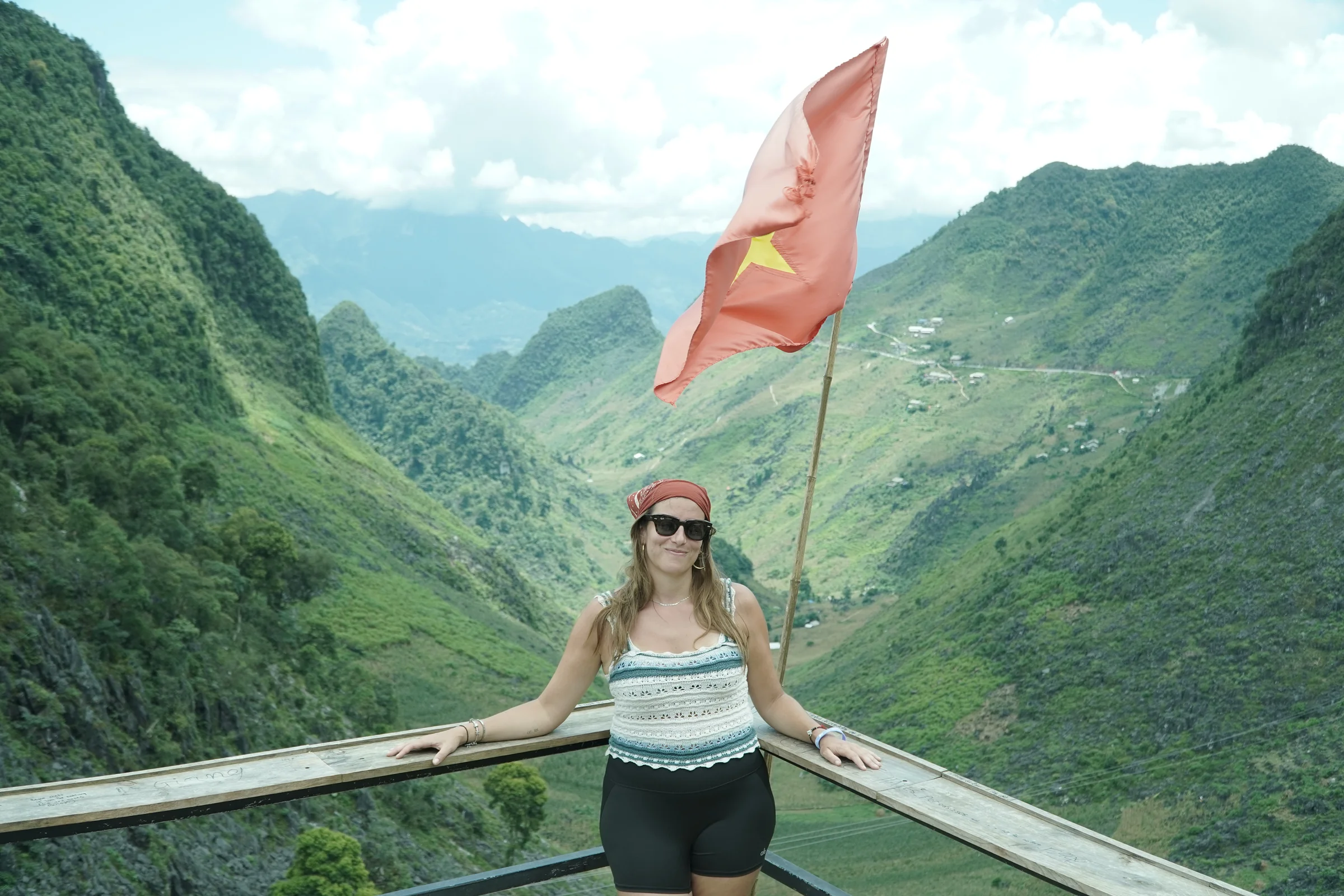
What if you do not want to ride?
Perfectly reasonable, and the options are real but narrower than elsewhere in Vietnam.
Riding pillion behind a local rider is what most non-riders do, and it is the version this site would recommend to anyone without solid experience. A car or jeep with a driver works and puts glass between you and the thing you came for. Walking is genuinely good in the western districts and limited on the main loop, because the distances are built for engines.
The decision that changes your trip most is not which activity you pick, it is this one. Self-drive versus an easy rider works through it, and riding without experience is the honest version rather than the encouraging one. If you are weighing operators at all, how to choose a Ha Giang Loop tour gives you criteria rather than a recommendation.
What does any of this cost?
Most of it costs nothing. Markets, viewpoints, villages, passes and the plateau are free and open, and the money in a Ha Giang trip goes on transport, beds and food rather than on attractions.
The paid items are small and specific: the Nho Que boat, a handful of cave and site entrance fees, parking at the busier viewpoints, and a permit for certain border areas. All of it is cash. ATMs and cash in Vietnam covers why you should draw it before you leave the city, and what the Ha Giang Loop costs has the full breakdown.
Which is the useful frame for this whole page: you are not buying attractions here. You are buying days, and what you do with them is mostly free.
Common questions
What is there to do in Ha Giang besides the Loop?
Weekly ethnic minority markets that rotate between towns, trekking in the western terraced districts of Hoang Su Phi and Xin Man, the Nho Que river boat, caves and viewpoints across the Dong Van karst plateau, and the Lung Cu flag tower at Vietnam’s northernmost point. Most of it is free and open, and the markets are the thing most worth planning around.
Is the Nho Que boat trip worth it?
Yes, but manage the expectation. It is a roughly forty-minute float through a very deep canyon, with a queue at each end and a steep descent to the jetty. The scale is genuinely impressive and does not photograph well. Go early; in high season the wait can exceed the trip.
Do you need to book activities in Ha Giang in advance?
Mostly no. Markets, viewpoints, villages and passes are free and open. What is worth arranging in advance is transport and, if you are not riding yourself, a rider. Border-area permits are arranged locally and quickly.
Can you do Ha Giang without riding a motorbike?
Yes, though the options are narrower than elsewhere in Vietnam. Riding pillion with a local rider is the most common answer for non-riders. A car or jeep with a driver works. Walking is rewarding in the western districts and impractical as a way of covering the main loop.
When should you come for the terraces?
September and October, when the rice in Hoang Su Phi and Xin Man is gold before harvest. That is also a good window for the main route, since the northern dry season is starting. The month-by-month picture is in Ha Giang’s own weather guide.
A note on how this page is written. I have an obvious commercial history here and the disclosure at the top says so. The test I have applied to every section is whether it would be written the same way by someone with nothing to sell. That is why the paragraph about “adventure” packages is where it is, why the Nho Que boat is described as a queue as well as a canyon, and why the recommendation that costs an operator most, which is that the best things here are free and unbookable, is the one the page ends on.
Leave a Reply