Key Takeaways
- There is no train and no airport. Every option is a road journey of roughly six to eight hours, and the choice is about comfort and arrival time, not speed.
- The overnight sleeper is the cheapest and the most popular. It also drops you in Ha Giang between 4am and 6am, hours before anything opens.
- That arrival time is the single biggest planning mistake people make here, and it has a safety consequence, not just an inconvenience.
- A daytime departure costs the same and solves it. Almost nobody tells you this because the night bus sells better.
- Book a bed for the night you arrive, not the night you start riding. One extra night fixes the whole problem.
Disclosure, before anything else
This site sells you nothing. No tours, no bookings, no affiliate links, and nothing on this page earns me anything whichever bus you take. I do still own a share of a Ha Giang tour company I no longer run, so I benefit if you book with them. I mention it on every page rather than choosing when it suits me.
Start with the thing that surprises people: there is no train to Ha Giang, and no airport. Whatever you choose, you are going by road for six to eight hours.
So the real question is not how to get here. It is what time you want to arrive, and almost every guide skips that.
How do you get from Hanoi to Ha Giang?
Four options, all on the same road.
Sleeper bus. The standard option. Rows of flat reclining berths, usually overnight. Cheapest, and what most travellers take.
Cabin sleeper. The same idea with individual enclosed pods instead of open berths. More privacy, more money, and much easier if you sleep badly.
Limousine. A minibus with wide reclining seats and fewer passengers. Usually the fastest, often around six hours, and generally the most comfortable if you are awake for it.
Private car. Door to door, on your schedule, several times the price. Worth it for a group of four splitting the cost, or if you are arriving on a tight connection.
Most departures leave from Mỹ Đình bus station on Hanoi’s west side, though limousine operators often collect you from the Old Quarter, which saves a taxi across the city.
How much does the bus to Ha Giang cost?
Fares in circulation in August 2026, quoted per person one way:
| Option | Typical fare | Roughly |
|---|---|---|
| VIP sleeper | 200,000 to 350,000 VND | $8 to $14 |
| Cabin sleeper | 400,000 to 550,000 VND | $16 to $22 |
| Limousine | 450,000 to 600,000 VND | $18 to $24 |
| Private car | Considerably more, varies by operator | varies |
Fare ranges are compiled from operator listings on Vexere, Vietnam’s main bus ticketing platform (retrieved 2026-08-02). I am citing a ticketing marketplace rather than a Ha Giang tour company’s own page, because a tour company quoting you the price of the bus that brings you to its door is not a neutral source.
Treat these as the shape of the market in August 2026, not a quote. Fares move with season and demand, and they climb around Tet and public holidays. Check the live price before you budget, and see the full cost breakdown for where this sits in the trip total.
The gap between the cheapest sleeper and a limousine is roughly ten dollars. Ten dollars is not usually what decides this. Arrival time is.
The 4am problem
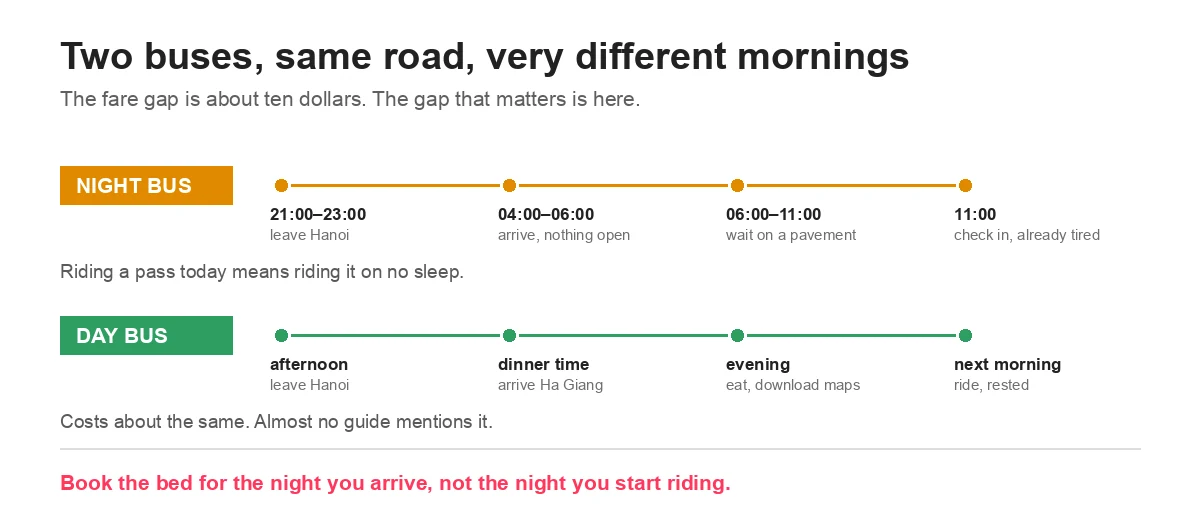
Here is what actually happens on the standard overnight bus, and it is the most useful thing on this page.
Departures cluster between about 9pm and 11pm. The journey takes seven to eight hours. Which means you are put down in Ha Giang city somewhere between 4am and 6am.
At that hour nothing is open: rental shops are shut, tour offices are shut, and your homestay will not check you in for another five or six hours. You are standing on a pavement in the dark with a backpack, having slept badly on a moving bus, and you have several hours to fill before the day can start.
That is the inconvenience. Here is the part that matters more.
A lot of people push straight on and start riding that same morning. You would be taking a mountain road with hairpins and blind bends on close to no sleep. Tiredness is not on the list of four causes in the safety guide because it is not a separate cause. It makes all four of them worse.
So what should you do instead?

Three fixes, in order of how much I would recommend them.
- Book a bed for the night you arrive. Pay for the room from the previous night so it is yours at 5am, sleep properly, and start riding the next morning. This costs one extra night and removes the entire problem.
- Take a daytime departure instead. They exist, they cost about the same, and they arrive in the evening at a normal hour. An afternoon departure gets you in around dinner time, you sleep in a bed, and you start fresh. Almost no guide mentions this, because the night bus is what sells.
- Take the limousine and accept the arrival. If you must go overnight, at least arrive rested. Then spend the first morning doing nothing.
If you are landing in Hanoi and heading north the same week, work backwards from the ride, not forwards from the flight. Decide which morning you want to be on the bike fresh, then book the bus so that morning is not the one you spend recovering from a night on a bus.
One thing that is about to change
Worth knowing if you are planning more than a few months ahead, because it will shorten this journey.
A new expressway is being built between Tuyên Quang and Hà Giang, running about 165 km. The first phase reached technical opening in December 2025, and the provincial authorities have been pushing for the full route to be operational around the end of the third quarter of 2026. As of mid-July 2026 the works were reported at roughly 77% of contract value.
What that means in practice is that the slowest, most winding part of the drive north is gradually being replaced with a faster road. Nobody should book a trip on the assumption that it is finished, because infrastructure timelines move. But if you are reading this a year after I wrote it, check before you assume the journey still takes eight hours, because it may well not.
I am flagging this partly because it is useful and partly because it is the kind of thing that quietly makes travel articles wrong. Most English-language guides to this route have not been updated since the road was announced.
Progress and timeline from VietnamPlus and the Tuyên Quang provincial portal, both retrieved 2026-08-02. Both are Vietnamese sources, which is where this information exists.
Which one should you pick?
- Travelling alone on a budget: standard sleeper, daytime departure if the timing works.
- You sleep badly on buses: cabin sleeper. The pod is worth the extra ten dollars precisely because of the safety point above.
- You are tall: limousine. Sleeper berths are built for a Vietnamese average height and a lot of visitors do not fit comfortably.
- Group of three or four: price a private car. Split four ways it stops looking extravagant, and you can leave when you like.
- You get motion sick: daytime, front of the vehicle, and eat lightly. The road climbs and turns for the last two hours whatever you booked.
What is the road actually like?

Mostly good, and better than it was a few years ago. The route runs north-west out of Hanoi through Tuyên Quang, and although the early stretch is straightforward, the last two hours into Ha Giang climb and wind steadily.
Two practical notes. Buses stop once or twice at roadside places for food and a toilet, so carry small notes. And phone signal is fine for most of the way, which will not be true once you are on the Loop itself.
Whatever month you come, check what the weather is doing before you commit to a schedule with no slack in it. The month-by-month picture has that.
A note on method: the fares above are operator listings on a Vietnamese ticketing platform, retrieved August 2026, and I have marked them as a range rather than a quote. The arrival-time observation is not from a source; it is what I watch happen from here, week after week, and it is the reason this page exists in the shape it does.
Hanoi to Ha Giang: common questions
How long does it take to get from Hanoi to Ha Giang?
Roughly six to eight hours by road. A limousine is usually at the faster end, around six hours. An overnight sleeper takes seven to eight, partly because it is not trying to hurry.
Is there a train or a flight to Ha Giang?
No. There is no railway line and no airport serving Ha Giang. Every route is by road from Hanoi.
How much is the bus from Hanoi to Ha Giang?
In August 2026, a VIP sleeper ran roughly 200,000 to 350,000 VND, about $8 to $14. Cabin sleepers and limousines ran roughly 400,000 to 600,000 VND, about $16 to $24. Fares rise around Tet and holidays.
What time does the night bus arrive in Ha Giang?
Usually between 4am and 6am. Nothing is open at that hour and your homestay will not check you in for several more. Book the room from the night before so you can sleep on arrival.
Can I start riding the Loop the same day I arrive?
You can, and many do, but after an overnight bus you would be taking mountain roads on very little sleep. Tiredness makes every other risk on that road worse. A daytime bus or an extra night solves it cheaply.
Where does the bus leave from in Hanoi?
Most services leave from Mỹ Đình bus station on the west side of the city. Limousine operators frequently pick up in the Old Quarter instead, which saves you a taxi across Hanoi.
Pick the option that puts you in a bed before you ride, not the one that saves ten dollars. That is the whole of the advice on this page.
Written by Jasmine (Thuy Bui), born and raised in Ha Giang. This site sells nothing and carries no affiliate links. I co-founded Jasmine Ha Giang, a licensed local tour operator, and I still hold a share in it; the team there operates it without me. My work now is free advice for travellers and social projects in the province.
Leave a Reply