Key Takeaways
- “Rainy season” is one name for three unrelated weather events. In the south it is an afternoon thunderstorm. In the north it is monsoon humidity. On the central coast it is flooding.
- Only one of the three should change your itinerary, and it is the central coast between September and December.
- Vietnam gets 1,500 to 2,500 mm of rain a year, and it does not arrive evenly. It arrives in a small number of intense events, which is why an average is useless for planning.
- Buy the 20,000 ₫ plastic poncho at the roadside. It beats the jacket you brought, and everyone local already knows this.
- The wet season is cheaper, emptier and greener. For two of the three regions that is a genuinely good trade.
The phrase does more damage than the weather does.
Someone reads “rainy season, May to November”, pictures six months of grey, and books a different country. What they were actually being warned about was a two-hour thunderstorm at four in the afternoon that they could have planned lunch around.
This article is about what the rain actually does. If you want to know which month to go and which region to point the trip at, that is a different question and the best time to visit Vietnam answers it with a month-by-month grid.
What does “rainy season” actually mean in each region?
Three regions, three completely different experiences, one shared label. This is the single most useful thing to understand about the subject.
The south: a scheduled thunderstorm. Ho Chi Minh City and the Mekong, roughly May to November. The rain arrives as a brief, heavy afternoon or evening downpour and then it stops. You get wet if you are outside for it. You lose an hour or two, not a day. Locals stop, drink something, and carry on.
The north: humidity with downpours in it. Hanoi, Sa Pa and Ha Giang, roughly May to September, worst in July and August. Longer and heavier than the southern version, and the real character of the season is the humidity rather than the rain itself. Mountain paths turn slippery and stay that way. The landscape, in exchange, is at its most spectacular.
The central coast: the one that matters. Hue, Da Nang and Hoi An, September to December, peaking in October and November. High rainfall, occasional typhoons, and periodic coastal flooding. Selective Asia puts it starkly: almost half the annual rainfall falls in October and November. Hoi An’s old town floods most years, sometimes to the point where people move around it by boat.
Only the third one is a planning problem. The first two are a packing problem.
How much rain is it, really?
Vietnam Airlines gives the national figure: 1,500 to 2,500 mm of rainfall annually, retrieved 11 August 2026.
That number is worth doing something with, because on its own it sounds apocalyptic. Take the middle of the range, 2,000 mm, and assume most of it lands in a six-month wet season. Spread evenly, that is about 11 mm a day, which is a damp afternoon in northern Europe.
It does not spread evenly. That is the entire point. A single tropical downpour can drop 50 mm in an hour, which means the season’s rain arrives in something like a few dozen concentrated events rather than a daily drizzle. Most days in a “rainy season” are not rainy days. Some are extraordinary.
The practical consequence: plan around events, not around the season. Check the forecast for the next 48 hours, which is reliable, and ignore the fact that the month is labelled wet, which tells you almost nothing about your Tuesday.
The most quoted real-world data point on this subject is still a traveller on Reddit describing a week in Saigon in August: it rained on about half the days, in the afternoon. That is an anecdote rather than a measurement, but it matches the pattern well enough that it has been repeated for years, and it is a more honest expectation than either “six months of monsoon” or “it barely rains”.
What actually gets ruined, and what does not?
Ranked by how often it genuinely spoils something.
- Boat trips get cancelled. Ha Long Bay, Lan Ha and the Nho Que river boat all stop running when the weather turns. This is the most common way weather costs a traveller an actual item on their list, and it is a safety decision made by the operator, not something to argue with.
- Mountain roads get slower and more dangerous. Not closed, usually. Slower, with poorer grip and worse visibility, and with the small chance of a landslide on the steepest sections.
- Beaches stop being the point. Obvious, but people still book the central coast in October.
- Flights and buses mostly run. Typhoons ground flights for a day or two on the central coast. Elsewhere, ordinary heavy rain rarely stops transport.
- Cities barely notice. Hanoi and Ho Chi Minh City in the wet season are cities with wet pavements. Museums, coffee, food and markets are all indoors or under something.
The item most people worry about, street food, is the one least affected. Every stall has a tarpaulin and has had one for decades.
What should you actually pack?
Less than you think, and one thing you should buy after you land rather than before.
Buy the poncho here. The thin plastic poncho sold at every roadside stall for around 20,000 ₫ is better than the technical jacket in your bag, for the specific reason that it covers you and the bag and the front of the bike all at once, and because it is expected to be disposable. A breathable waterproof jacket is a worse tool in this climate: it is hot, and it soaks through eventually anyway.
Dry bags, not a rain cover. One dry bag for electronics and one for a change of clothes does more than anything else on this list. Rain cover on a backpack is a suggestion, not a seal.
Sandals you can walk in. Wet trainers stay wet for two days in this humidity, and then they smell. Locals wear sandals in the rain for a reason that becomes obvious on day three.
Quick-dry clothing, and less of it. Cotton does not dry. Laundry is cheap and same-day almost everywhere, so a small quick-dry wardrobe beats a large slow-drying one.
What about riding in it?
Riding a motorbike in heavy rain is a different risk from walking in it, and it is worth being blunt about that rather than folding it into a packing list.
Wet roads in the northern mountains mean less grip, longer braking distances, poorer visibility for you and for the truck coming the other way, and mud washed onto the tarmac at exactly the corners you would least like it. None of that makes the trip impossible. It makes it a slower trip that needs more space left around every decision.
The site’s honest treatment of that is elsewhere, because it deserves more room than a section:
- Which sections of the Ha Giang Loop are actually dangerous, segment by segment.
- What actually goes wrong up there, and how riders get hurt.
- Self-drive versus riding pillion, which is the decision that changes wet-weather risk the most.
If your trip lands in July or August and you have never ridden, the wet season is the strongest argument there is for taking a rider instead of a rental.
Is the wet season actually worth travelling in?
For the north and the south, often yes.
Prices drop, the crowds thin out at sites that are unpleasant when busy, and the landscape is at its best. Rice terraces are green and full of water rather than brown stubble. Waterfalls have water in them. The light after a storm is the light every photograph of Vietnam you have ever admired was probably taken in.
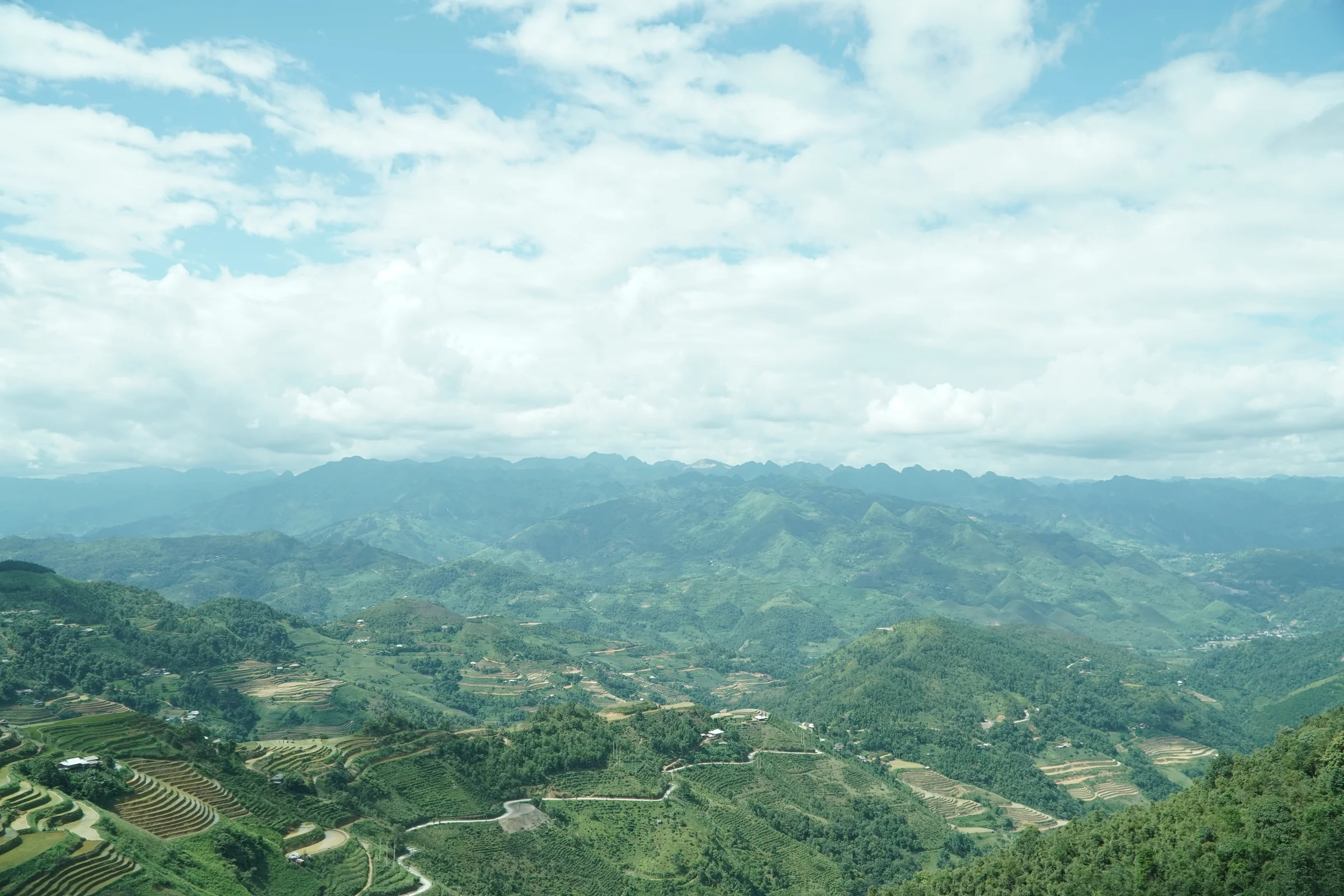
The trade is real, though, and it is not the rain. It is the humidity in the north in July, which is genuinely tiring, and the loss of the boat trips.
For the central coast between September and December, the honest answer is no, or at least not for the beaches and not without a flexible itinerary. That is the one region where the season does not just make you damp.
Common questions
What is the rainiest month in Vietnam?
It depends on the region, and the gap is large. July and August are the wettest months in the north. October and November are the wettest on the central coast, and Selective Asia notes that almost half the annual rainfall there arrives in those two months. In the south the rain is spread more evenly from May to November.
Which month should you not visit Vietnam?
There is no month that is bad everywhere. The pairing to avoid is the central coast in October and November, which is the peak of its wet season and the concentrated typhoon window. In the same months the north is entering its best season.
Does it rain all day during Vietnam’s rainy season?
Rarely, and almost never in the south, where the pattern is a heavy afternoon or evening storm that clears. The north gets longer spells. Persistent all-day rain is mostly a central-coast phenomenon during its wet months.
Do I need a raincoat for Vietnam?
Not from home. Buy a plastic poncho at a roadside stall for around 20,000 ₫, which is under a dollar. It covers you, your bag and the front of a motorbike at once, and it works better in this heat than a breathable waterproof jacket. Bring dry bags instead of a coat.
Will a typhoon ruin my trip?
Probably not, but it can cost you days if you are on the central coast between September and November. A typhoon typically grounds flights and closes boat trips for one to three days. The practical protection is a flexible booking and not putting your only two coastal days in that window.
Is the Ha Giang Loop possible in the rainy season?
Yes, and many people ride it in July and August. It is slower, the grip is worse and the views come and go with the cloud. If you have never ridden a motorbike, the wet season is the strongest reason to go with an easy rider rather than self-drive.
A note on method. The regional patterns and the annual rainfall range come from the sources linked above, retrieved 11 August 2026. The per-day arithmetic is mine and is labelled as such: it is there to show that an annual total tells you nothing about a given afternoon, not to predict one. The bars in the diagram are illustrative of each region’s known pattern rather than a record of measured rainfall. Where this article gives a month range it is deliberately coarse, because the precise question of when to go where is answered properly in a separate article rather than half-answered here.
Leave a Reply