Key Takeaways
- The two options are not the same product. A local SIM is registered to your passport under Vietnamese law. An international eSIM roams onto a Vietnamese network and sits outside that system entirely.
- For most travellers a local SIM is cheaper and works better in the mountains. An eSIM is easier and lands you connected before you clear the airport.
- Coverage on the Loop is not uniform. Whichever you buy, expect stretches with nothing, and plan for that rather than being surprised by it.
- Download your offline maps in Ha Giang city, not on the pass. This single habit matters more than which SIM you chose.
- Every other guide to this question earns a commission on your answer. This one does not, and you should weigh both accordingly.
Disclosure, before anything else
This site sells you nothing. No tours, no bookings, and in this article specifically, no affiliate links to any eSIM provider. That is worth saying because almost every “best eSIM for Vietnam” page you will find is paid a commission when you buy through it, which is exactly why they all recommend an eSIM. I do still own a share of a Ha Giang tour company I no longer run, which is irrelevant to this page but I say it on every page rather than choosing when to mention it.
There are two genuinely different things being sold under the same search, and almost nobody separates them properly. So here is the separation first, then what it means for you.
What is the difference between a Vietnam eSIM and a local SIM?
The difference is legal, not technical.
A local SIM is registered to you. Vietnamese law requires a subscriber’s identity to be recorded and authenticated. For a foreign visitor that means a valid passport, and the seller has to authenticate the details rather than just photocopy them. An expired passport does not work. This is set out in Nghị định 163/2024/NĐ-CP, Điều 18, retrieved 2026-08-02.
An international eSIM is not registered to you, because you are not a Vietnamese subscriber. You are roaming on a Vietnamese network through a foreign provider. That is why those providers can sell you a plan online with no passport and no shop visit.
Neither is a loophole. They are simply two different arrangements, and the practical consequences follow from that.
Two more places to check this if you want to, both Vietnamese and both public: Thư viện Pháp luật on the identity documents accepted for SIM registration (retrieved 2026-08-02), and Người Lao Động on how subscriber authentication works in practice (retrieved 2026-08-02). I am linking Vietnamese sources rather than an English travel blog on purpose, because the rule is Vietnamese and the travel blogs are mostly repeating each other.
Which one should you actually buy?
Here is the honest split, and it is not the one most pages give you.
- If you want to land connected and cannot be bothered, buy an international eSIM before you fly. It activates on arrival, you skip the counter, and you pay a premium for that. It is a fine choice and I will not pretend otherwise.
- If you are here for two weeks or more, buy a local SIM. It is several times cheaper for the same data, and the price difference stops being trivial.
- If you are riding the Loop, lean local. Coverage in the mountains is the whole argument, and I come back to it below.
- If your phone is older or locked, check it takes an eSIM at all before you plan around one. Plenty do not.
How much does a SIM card cost in Vietnam?
Tourist data plans from the Vietnamese carriers were advertised at roughly 120,000 to 200,000 VND (about $5 to $8 USD) for 30 days, depending on the data allowance, checked August 2026. That buys you a lot of data by most countries’ standards.
An international eSIM for the same period generally costs several times that. You are paying for convenience and for the provider’s margin, which is a real service, just an expensive one.
Those carrier prices are what retail listings advertised in August 2026, not a quote I can guarantee at a counter. Vietnamese mobile pricing moves and airport kiosks sometimes charge more than a carrier shop in town. Treat the range as the shape of the market, then ask at the counter and check the plan on the receipt before you walk away.
For where this sits in a whole-trip budget, the full Ha Giang Loop cost breakdown has the rest of the numbers.
Which network works best on the Ha Giang Loop?

This is the part a generic Vietnam guide cannot tell you, and it is the only part of this page that is really about where I live.
Viettel has the widest rural reach. It is the network most locals here use, and on the high sections it is usually the one still showing bars when the others have given up. If you buy one SIM and you are riding the Loop, that is the default.
But I want to be careful not to oversell it. Coverage on this route is not continuous on any network. There are stretches on the passes and down in the valleys where you will have nothing at all, sometimes for twenty minutes of riding. That is not a fault in your SIM. It is terrain. Limestone karst and deep valleys block signal in ways that a coverage map drawn at province level does not show you.
So the correct mental model is not “which network gives me signal everywhere”. It is “I will be offline sometimes, so what do I do about it”.
Download the offline map for the whole province while you are still in Ha Giang city, on wifi, the night before you ride. Google Maps and Maps.me both let you do this. It takes five minutes and it removes the single most common reason people get properly lost up here.
What to do before you lose signal
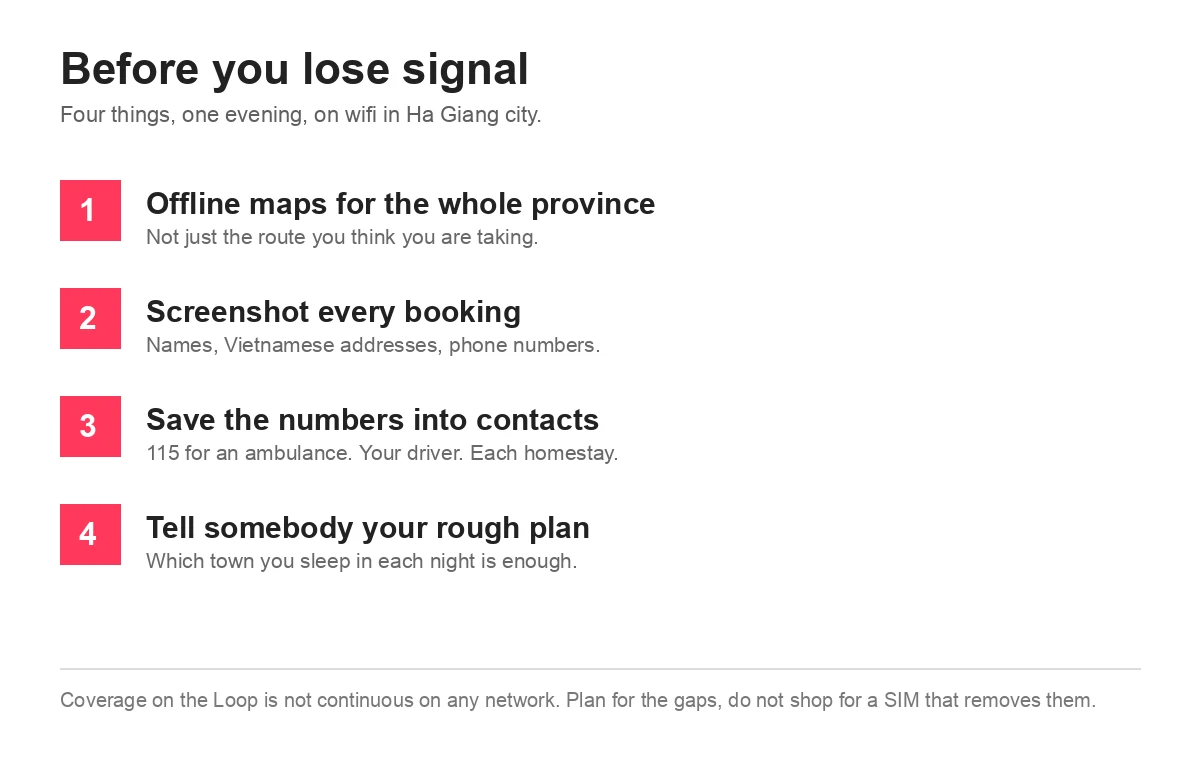
Four things, and they take one evening.
Offline maps for the whole province. Not just the route you think you are taking. The route you actually take will differ, because of weather, roadworks, or somebody’s suggestion at breakfast.
Screenshot your homestay bookings. Names, addresses in Vietnamese, phone numbers. A screenshot works with no signal. An email in an app usually does not.
Save the numbers that matter into your contacts. 115 for an ambulance, your driver or rental shop, and your homestay for each night. Saved, not sitting in a chat thread you need data to open.
Tell somebody your rough plan. Which town you are sleeping in each night is enough. If you go quiet for a day because you are in a valley, nobody needs to panic.
That last one costs nothing and it is the one people skip. The safety guide covers what to do when something actually goes wrong.
Where should you buy a SIM in Vietnam?
Three places, in descending order of how much I would trust them.
- An official carrier shop in a city: best prices, proper registration, and somebody who can fix it if the plan does not activate. Slowest option.
- The airport counter on arrival: fast, legitimate, and usually a little more expensive. A reasonable trade if you have just got off a long flight.
- A phone shop or a stall: fine in practice, but this is where mis-sold plans happen. Ask what the plan actually includes and check the receipt.
Whichever you pick, you will need your passport, and the seller is required to authenticate it rather than glance at it. If somebody offers to sell you a pre-registered SIM with no passport at all, that SIM is registered to a stranger. Walk away. It is not worth the twenty minutes you save.
Do you need data at all on the Loop?

Less than you think, and this is worth saying because it cuts against the whole premise of the search you just made.
With offline maps, saved numbers and screenshotted bookings, you can ride the entire Loop with no data and lose almost nothing. Homestays have wifi in the evenings. The road does not require navigation for long stretches because there is only one road.
What data actually buys you is the ability to change your mind: to reroute when the weather turns, to call ahead when you are running late, to check whether the pass is clear. Those are worth having. They are not worth paying five times the local price for.
A note on method: the legal points on this page cite the Vietnamese decree that governs subscriber registration. The prices are what retail listings advertised in August 2026, and I have marked them as such rather than presenting them as a quote. I have not linked to a single eSIM provider, because the moment I do, you can no longer tell whether the recommendation or the commission came first.
Vietnam SIM and eSIM: common questions
Do I need a passport to buy a SIM card in Vietnam?
Yes, for a local Vietnamese SIM. Nghị định 163/2024/NĐ-CP requires subscriber details to be recorded and authenticated, and for a foreign visitor the accepted document is a valid passport. An expired one does not qualify. An international eSIM sits outside this system and does not require it.
Is an eSIM better than a local SIM in Vietnam?
It is more convenient and more expensive. A local SIM gives you more data for less money and generally better rural coverage. If you are here briefly and value landing connected, the eSIM is a fair trade. For two weeks or more, the price gap gets hard to justify.
Which network has the best coverage on the Ha Giang Loop?
Viettel has the widest rural reach and is what most people here use. But no network covers the whole route. Expect dead stretches on the passes and in the valleys regardless of what you buy.
How much does a Vietnamese tourist SIM cost?
Tourist data plans were advertised at roughly 120,000 to 200,000 VND, about $5 to $8 USD, for 30 days, checked August 2026. Airport counters often sit at the top of that range or above it.
Can I ride the Ha Giang Loop with no data at all?
Yes, and plenty do. Download offline maps for the province, screenshot your bookings, and save the numbers you might need. Data mainly buys you the ability to change plans mid-route, which is useful but not essential.
Should I buy at the airport or wait?
The airport is legitimate and fast, and usually a little more expensive. A carrier shop in the city is cheaper and better if something needs fixing. Either is fine. A stall offering a pre-registered SIM with no passport is not.
Buy whichever suits you, then spend the evening before you ride downloading maps and saving numbers. That evening does more for the trip than the SIM decision ever will.
Written by Jasmine (Thuy Bui), born and raised in Ha Giang. This site sells nothing and carries no affiliate links. I co-founded Jasmine Ha Giang, a licensed local tour operator, and I still hold a share in it; the team there operates it without me. My work now is free advice for travellers and social projects in the province.
Leave a Reply