Key Takeaways
- A Vietnamese sleeper bus has berths, not seats. You lie down. This surprises almost every first-time visitor.
- Shoes come off at the door and go in a plastic bag you carry with you. Nobody tells you this and everybody has to do it.
- There are three classes: open-berth sleeper, enclosed cabin, and limousine. The gap between them is usually a few dollars.
- Berths are built for a Vietnamese average height. If you are over about 1.8 m, budget for a cabin or a limousine rather than hoping.
- The night bus is not automatically the right choice. It saves a hotel night and costs you the next morning.
Disclosure, before anything else
This site sells you nothing. No bookings, no affiliate links, and no commission whichever bus you take. I do still own a share of a Ha Giang tour company I no longer run, so I benefit if you book with them. It has nothing to do with buses, and I say it on every page rather than choosing when it suits me.
The first time somebody boards a Vietnamese sleeper bus, there is usually a moment of confusion at the door. Here is what is about to happen, so you can skip that.
What is a Vietnamese sleeper bus?
It is a coach fitted with berths instead of seats. Two or three rows of them, stacked in two levels, running the length of the vehicle. You lie down for the whole journey.
Each berth is a moulded plastic shell with a thin mattress, a footwell your feet slide into, and a backrest that reclines to nearly flat. There is a seatbelt. Use it.
This is the standard for any journey over about four hours in Vietnam. It is not a luxury upgrade. It is simply how long-distance buses here are built, and it is genuinely more comfortable than sitting upright for eight hours.
The three things nobody tells you
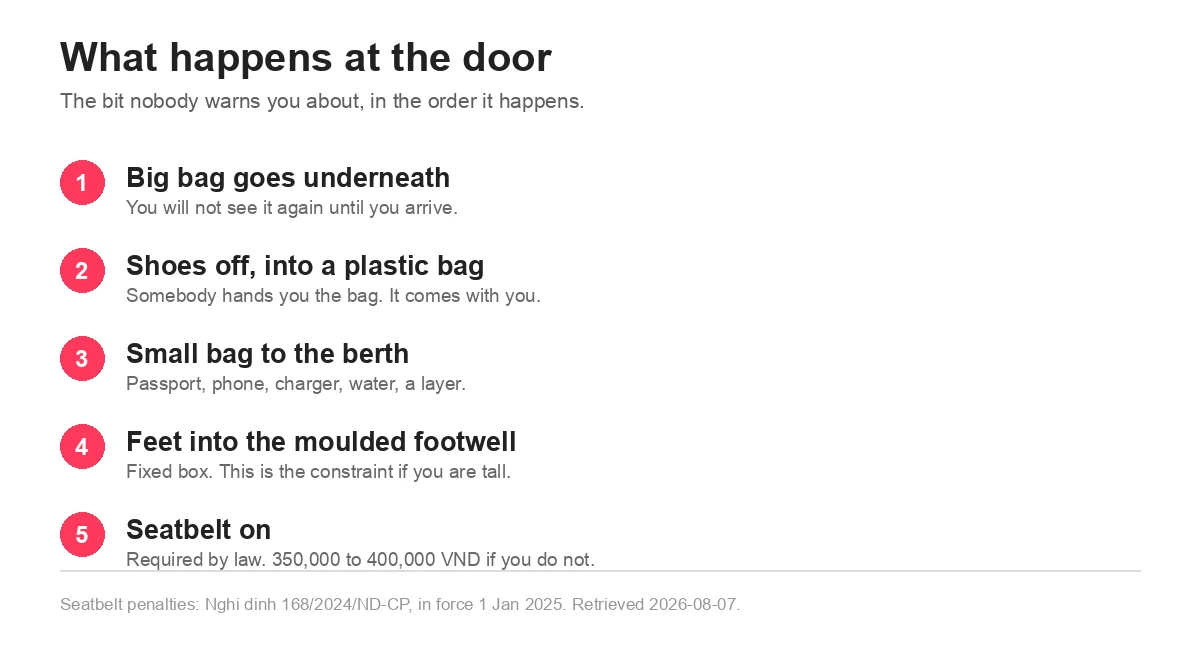
Your shoes come off at the door. Somebody will hand you a thin plastic bag. Shoes go in it, the bag comes with you to your berth. Do not leave them in the aisle, and do not be the person who tries to keep them on.
Your big bag goes underneath. It is stowed in the luggage compartment and you will not see it again until you arrive. Keep passport, phone, charger, water and anything you need overnight in a small bag you take to the berth.
The footwell is narrow and enclosed. Your feet go into a moulded box under the berth in front. It is fine, but it is not somewhere you can stretch or turn over easily, which matters more the taller you are.
The three classes, and what the money buys
| Class | What it is | Comfort | Roughly |
|---|---|---|---|
| Standard / VIP sleeper | Open berths in rows, no partition | Fine. Everybody can see everybody | Cheapest |
| Cabin sleeper | Individual enclosed pod with a door or curtain | Private, quieter, much easier to sleep in | Middle |
| Limousine | Fewer, wider reclining seats or pods, smaller vehicle | Most space, often faster, feels like a minibus | Dearest |
Class definitions and the fare structure are visible across operator listings on Vexere, Vietnam’s main bus ticketing platform (retrieved 2026-08-02). I am citing a ticketing marketplace rather than any operator’s own page, because an operator describing its own product is not a neutral source.
On most routes the whole spread between cheapest and dearest is a matter of a few dollars. That is worth sitting with for a second, because people agonise over it and then have a bad night to save the price of a coffee.
Which class should you book?
- Short daytime hop, under five hours: standard sleeper is fine. You are not really sleeping anyway.
- Overnight, and you sleep badly: cabin. The door or curtain is the difference between dozing and actually sleeping, and it costs very little.
- You are tall: limousine, or cabin at minimum. See below.
- Travelling alone and slightly nervous: cabin. A partition helps more than you would expect.
- Prone to motion sickness: any class, but book low deck and towards the front, and eat lightly beforehand.
What if you are tall?
Berths are sized for the Vietnamese average, and that is shorter than the average northern European or North American traveller.
If you are around 1.8 m or above, a standard berth will be tight, and above about 1.9 m it can be genuinely uncomfortable for a whole night. The footwell is the constraint, not the length of the mattress, because it is a fixed moulded box rather than open space.
Cabins and limousines are usually a little longer and a lot more adjustable. This is the single clearest case where paying the extra few dollars is not a comfort indulgence but a straightforward fix for a problem you would otherwise spend eight hours inside.
Ask for a lower-deck berth when you book. It is easier to get in and out of, it moves less on winding roads, and it is much better if you are tall or carrying anything you want to keep beside you.
Do you have to wear the seatbelt?
Yes, and this is the part almost no English-language guide mentions, so it is worth spelling out.
Every berth has a belt, and Vietnamese law requires you to use it. Under Nghị định 168/2024/NĐ-CP, in force since 1 January 2025, a passenger who does not wear a seatbelt where one is fitted can be fined 350,000 to 400,000 VND, and the driver faces 800,000 to 1,000,000 VND plus licence penalty points for carrying unbelted passengers.
Vietnamese reporting is fairly blunt that this is one of the most commonly ignored rules, and that sleeper buses are where it is ignored most. Enforcement on the expressways has been picking up.
Put the belt on even if nobody around you does. A berth is a moulded shell, and in a heavy braking event an unbelted passenger travels the length of it before anything stops them. The fine is not the reason to bother.
Seatbelt requirement and penalties under Nghị định 168/2024/NĐ-CP, effective 1 January 2025. Reporting on how it applies to sleeper buses specifically: VietnamNet and Báo Pháp Luật TP. Hồ Chí Minh, both retrieved 2026-08-07. Both are Vietnamese sources, which is where this exists.
Toilets, stops and food

Most sleeper buses stop once or twice at roadside places, and on a long route those stops are where you eat and use the toilet.
Some buses have a toilet on board and some do not. Do not assume either way, and do not board a long overnight route without checking. Bring small notes, because the roadside stops are cash places and nobody is going to break a large bill at 2am.
The stops are also the only real chance to stand up and move, so take them even if you do not need anything.
Night bus or day bus?

Here is where I disagree with most of the internet.
The overnight bus is sold as the efficient choice: you sleep on the road, you save a hotel night, you arrive with a full day ahead. That is true for the money and false for the morning.
You will sleep badly. Everybody does, at least the first time. And on a lot of routes the overnight service puts you down before dawn, which is not the same as arriving early. It is arriving at an hour when nothing is open and nothing can be done.
A daytime departure usually costs the same, gets you in at a normal hour, and lets you sleep in a bed. It is worth checking whether one exists on your route before defaulting to the night service.
That trade-off matters most on the routes where you plan to do something physical on arrival. On the Hanoi to Ha Giang run specifically, where people step off a night bus and get straight onto a motorbike, the arrival time is the whole problem.
A note on method: the practical details here are what these buses are actually like, from someone who lives at the end of one of these routes and takes them. The class definitions and fare structure are cited to a ticketing platform rather than an operator, because an operator describing its own product is not a neutral source.
What to bring
Six things, and the list is short on purpose.
- A small bag for the berth, with passport, phone, charger, water and a layer.
- A jumper or a scarf. Air conditioning on these buses is aggressive and there is no way to turn it down.
- An eye mask and earplugs. Lights stay on longer than you want and phones stay loud.
- Small notes for the roadside stops.
- A downloaded map or offline entertainment. Signal drops in and out on mountain routes. The SIM and connectivity guide covers that properly.
- Motion sickness tablets if you are at all prone. Take them before boarding, not when you start feeling it.
Sleeper buses in Vietnam: common questions
What is a sleeper bus in Vietnam like?
It has berths rather than seats, arranged in two levels along the vehicle. You lie down on a moulded shell with a thin mattress and a footwell for your feet. Shoes come off at the door and go in a plastic bag you take to your berth.
Do you have to take your shoes off on Vietnamese buses?
Yes. Somebody hands you a plastic bag at the door and your shoes go in it. It applies to everyone and it is not negotiable, so have footwear you can slip off easily.
What is the difference between a sleeper and a cabin bus?
A standard sleeper has open berths in rows. A cabin sleeper gives each passenger an enclosed pod with a door or curtain. The cabin is quieter and far easier to sleep in, usually for a few dollars more.
Are Vietnamese sleeper buses comfortable for tall people?
Standard berths are sized for the Vietnamese average and get tight around 1.8 m, uncomfortable above about 1.9 m. The enclosed footwell is the limitation. Book a cabin or limousine instead of hoping.
Do sleeper buses have toilets?
Some do and some do not, so check before booking a long overnight route. All of them stop once or twice at roadside places where you can use a toilet and eat. Carry small notes for those stops.
Should I take the night bus or the day bus?
The night bus saves a hotel night but you will sleep badly and may arrive before dawn, when nothing is open. A daytime service usually costs the same and gets you in at a sensible hour. Check whether one runs on your route before defaulting to the overnight.
Book the cabin, ask for a lower berth, and put your shoes somewhere you can reach them. That is most of what there is to know.
Written by Jasmine (Thuy Bui), born and raised in Ha Giang. This site sells nothing and carries no affiliate links. I co-founded Jasmine Ha Giang, a licensed local tour operator, and I still hold a share in it; the team there operates it without me. My work now is free advice for travellers and social projects in the province.
Leave a Reply